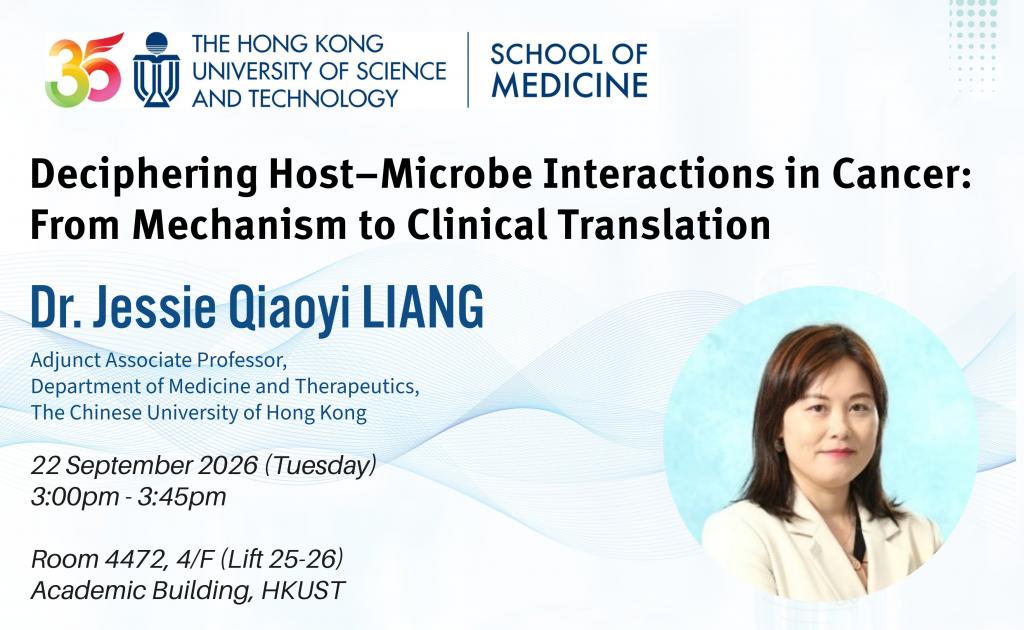
Deciphering Host–Microbe Interactions in Cancer: From Mechanism to Clinical Translation
Supporting the below United Nations Sustainable Development Goals:支持以下聯合國可持續發展目標:支持以下联合国可持续发展目标:
Cancer development is shaped by a complex interplay between microbiota and host genetics, yet translating this biology into clinical tools remains challenging. My research addresses this through four interconnected pillars: microbial mechanisms, host genetics, host–microbe interactions, and translational diagnostics/therapeutics. Using systems-biology approaches integrating multi-omics, molecular imaging, and organoid models, my team identified a novel carcinogenic bacterium, Enterocloster sp. M3, and elucidated how pathogens such as Fusobacterium nucleatum and protective commensals such as Agathobacter rectalis oppositely regulate cholesterol metabolism and tumorigenesis through shared molecular axes. These discoveries have been translated into clinical tools, including a commercially launched stool-based CRC screening test (M3CRC) and a pipeline of DNA-methylation and live-biotherapeutic candidates. This talk will present how mechanistic discovery, spanning gut microbiota dysbiosis, bacterial functional mechanisms to host signaling, can be systematically converted into clinically deployable solutions for cancer early detection and precision prevention.
Dr. Jessie Qiaoyi LIANG is a cancer researcher specializing in gut microbiome biology, cancer epigenetics, and translational diagnostics. She earned her PhD in Oncology from Zhejiang University School of Medicine before joining The Chinese University of Hong Kong, where she built a 15-year research career, most recently as Research Associate Professor and Principal Investigator at the Li Ka Shing Institute of Health Sciences. Her work has identified novel cancer-associated gut bacteria and genes, and translated these discoveries into clinical tools, including a commercially launched non-invasive colorectal cancer screening test. She has authored 121 publications (H-index 34, >7,100 citations), secured 22 grants as principal investigator, and is a named inventor on 56 patents, 18 already granted, underpinning four healthcare products. She has mentored 12 PhD students, including four Hong Kong PhD Fellowship Scheme awardees, and continues to teach courses in microbiota, probiotics, and epigenetics.
For enquiries, please contact Ms. TAM at 3469 2465.