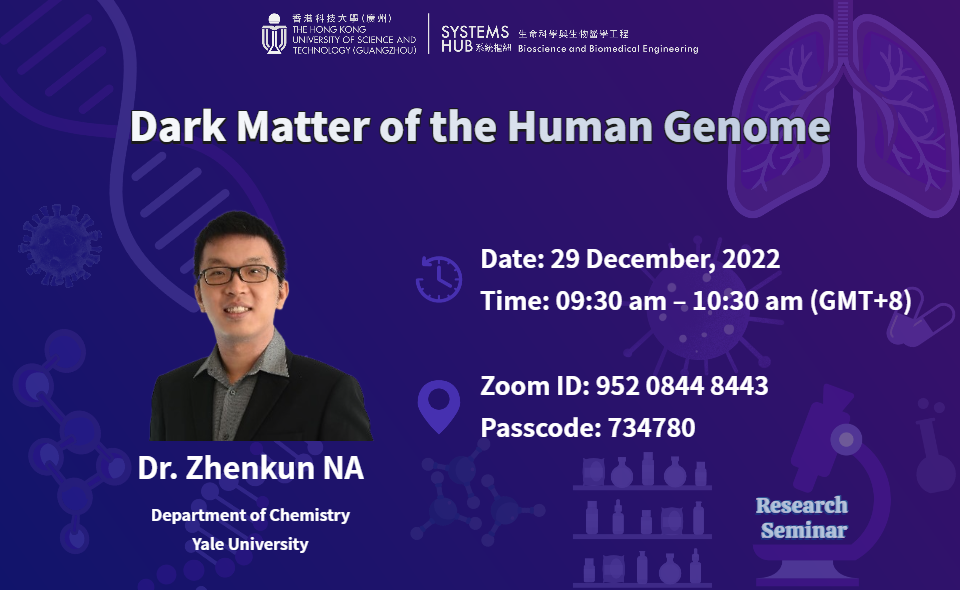
Dark Matter of the Human Genome
Supporting the below United Nations Sustainable Development Goals:支持以下聯合國可持續發展目標:支持以下联合国可持续发展目标:
ABSTRACT
Proteogenomic identification of translated small open reading frames in human has revealed thousands of microproteins, or polypeptides of fewer than 100 amino acids, that were previously invisible to geneticists. Microproteins have now been linked to important cellular and physiological processes as well as disease in diverse organisms. We developed a high-throughput technology for global mapping of microproteins to specific subcellular organelles by proximity labeling techniques and mass spectrometry-based proteomics. We demonstrated that this technology enables detection of hundreds of microproteins within specific subnuclear regions in cultured human cell lines and in mouse model. Meanwhile, we characterized the biological function of an intrinsically disordered microprotein, NBDY, and showed that NBDY is a master regulator of the substrate specificity of the cytoplasmic RNA decapping complex. We identified that phosphorylation of NBDY from phosphoproteomics downstream of signaling pathways that control cell division and response to growth factors is sufficient to drive the membraneless organelle (Processing bodies) disappearance in human cells.
BIOGRAPHY
Dr. Zhenkun Na currently is postdoctoral associate in the Department of Chemistry at Yale University. He completed his Ph.D. under the supervision of Prof. Shaoqin Yao in the Department of Chemistry at National University of Singapore in 2014. Then, he worked as research fellow with Prof. Haiwei Song at Institute of Molecular and Cell Biology, A*STAR, Singapore. After that, he moved to the US for his postdoctoral training with Prof. Sarah Slavoff in the Institute of Biomolecular Design and Discovery at Yale University, where he developed innovative proteomic tools to identify previously unannotated microproteins and to study their biological functions. In his academic career, he published 20 papers (9 first and co-first author paper) in top-ranked international journals such as Nat. Biotechnol., Mol. Cell, Cell Res., Nat. Commun., J. Am. Chem. Soc. and Angew. Chem. Intl. Ed.