CWB Philosophy of Science Lecture Series
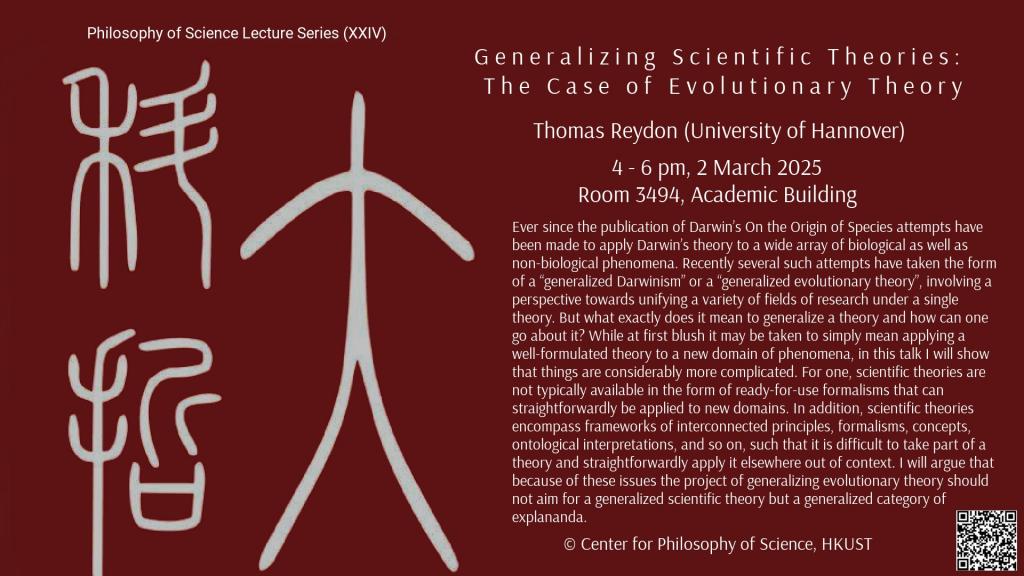
- Generalizing Scientific Theories: The Case of Evolutionary Theory
Supporting the below United Nations Sustainable Development Goals:支持以下聯合國可持續發展目標:支持以下联合国可持续发展目标:
Ever since the publication of Darwin’s On the Origin of Species attempts have been made to apply Darwin’s theory to a wide array of biological as well as non-biological phenomena. Recently several such attempts have taken the form of a “generalized Darwinism” or a “generalized evolutionary theory”, involving a perspective towards unifying a variety of fields of research under a single theory. But what exactly does it mean to generalize a theory and how can one go about it? While at first blush it may be taken to simply mean applying a well-formulated theory to a new domain of phenomena, in this talk I will show that things are considerably more complicated. For one, scientific theories are not typically available in the form of ready-for-use formalisms that can straightforwardly be applied to new domains. In addition, scientific theories encompass frameworks of interconnected principles, formalisms, concepts, ontological interpretations, and so on, such that it is difficult to take part of a theory and straightforwardly apply it elsewhere out of context. I will argue that because of these issues the project of generalizing evolutionary theory should not aim for a generalized scientific theory but a generalized category of explananda.
Thomas A. C. Reydon is a professor at University of Hannover, Institute of Philosophy Centre for Ethics and Law in the Life Sciences (CELLS). His research interests are Philosophy of Biology, Metaphysics, Epistemology, Metaphilosophy and Philosophy of Social Science.
For more information, please click here.
For general enquiries, please email philsci.ust.hk.