Control of Poly(A)-tail Length and Translational Efficiency in Vertebrate Oocytes and Early Embryos
Supporting the below United Nations Sustainable Development Goals:支持以下聯合國可持續發展目標:支持以下联合国可持续发展目标:
Abstract:
During oocyte maturation and early embryogenesis, changes in mRNA poly(A)-tail lengths strongly influence translation, but how these tail-length changes are orchestrated has been unclear. Here, we performed tail-length and translational profiling of mRNA reporter libraries (each with millions of 3ʹ-UTR sequence variants) in frog oocytes and embryos, and fish embryos. Contrasting to previously proposed cytoplasmic polyadenylation elements, we found that a shorter element, UUUUA, together with the polyadenylation signal, specifies cytoplasmic polyadenylation, and identified contextual features that modulate the activity of both elements. In maturing oocytes, this tail lengthening occurs against a backdrop of global deadenylation and the action of C-rich elements that specify tail-length-independent translational repression. In embryos, cytoplasmic polyadenylation becomes more permissive, and additional elements specify waves of stage-specific deadenylation. Together, these findings largely explain the complex tapestry of tail-length changes observed in early frog and fish development, and the neural network model PAL-AI indicate that many findings extend to humans, with implications for fertility and health.
Biography:
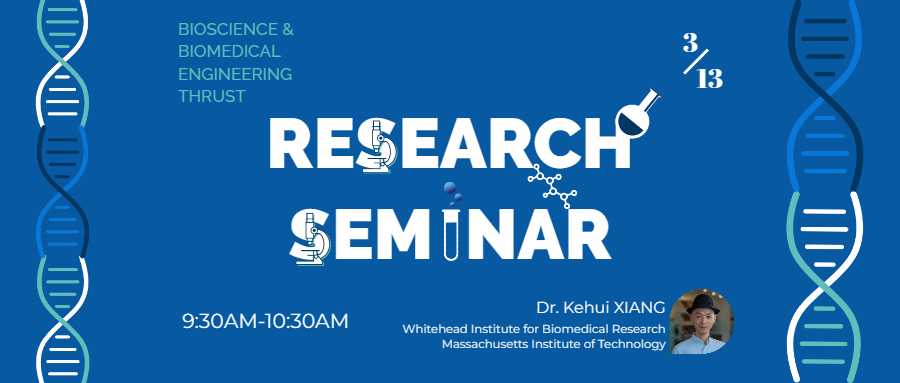
Dr. Xiang earned his bachelor’s degree in Mathematics and Physics from Tsinghua University and completed his Ph.D. in Biological Sciences at Columbia University. Presently, he serves as a postdoctoral associate at the Whitehead Institute for Biomedical Research, Massachusetts Institute of Technology. Dr. Xiang's research has been centered on RNA biology and post-transcriptional gene regulation during vertebrate early development. Employing a multidisciplinary approach, he integrates high-throughput system methodologies, RNA and protein biochemistry, functional genomic screens, and machine learning to unravel gene-regulatory mechanisms governing developmental transitions. His contributions have been published in Nature, eLife, Developmental Cell, and many other journals. Dr. Xiang has received Chinese Government Award for outstanding self-financed students abroad and CRI Irvington Postdoctoral Fellowship from Cancer Research Institute.