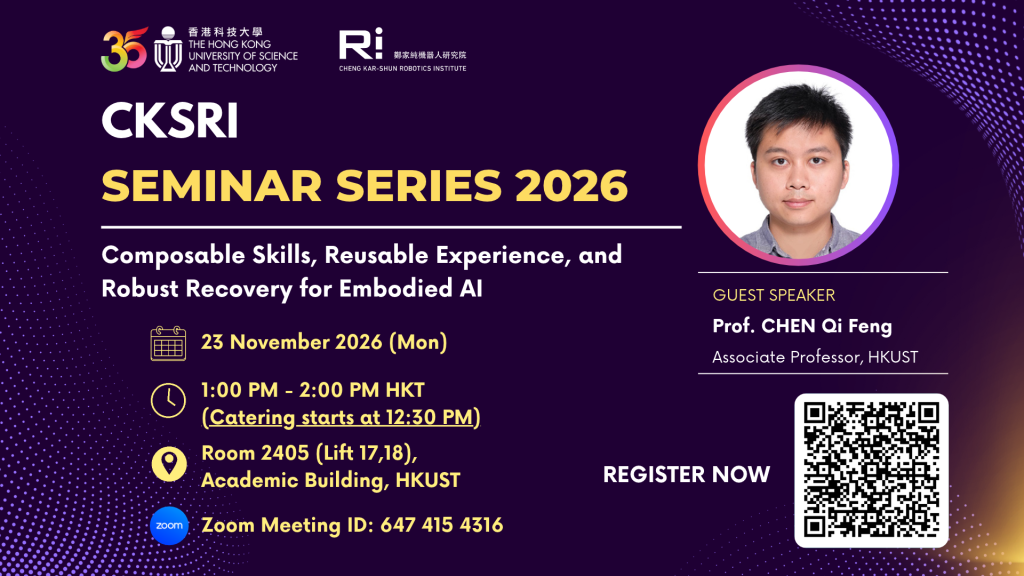
CKSRI Seminar Series 2026 "Composable Skills, Reusable Experience, and Robust Recovery for Embodied AI"
Supporting the below United Nations Sustainable Development Goals:支持以下聯合國可持續發展目標:支持以下联合国可持续发展目标:
Abstract
Long-horizon embodied tasks demand more than individual motor skills: robots must compose behaviors, learn from experience, and recover from failures while maintaining progress toward their goals. This talk presents complementary approaches to these challenges. First, a contact-based interface connects low-level humanoid control with high-level planning, enabling flexible skill composition and closed-loop recovery. Second, experience-driven robotic agents use frozen vision–language models to reflect on successes and failures, accumulating reusable strategies without updating model parameters. Third, a failure-aware recovery framework moves beyond local physical repair to restore states from which a frozen policy can successfully resume its task. Together, these projects explore how structured skills, reusable experience, and continuation-aware recovery can support more adaptable and reliable embodied intelligence
Prof. Qifeng Chen is an Associate Professor at the Hong Kong University of Science and Technology. He earned his PhD in Computer Science from Stanford University. His research interests include generative AI, computational photography, and autonomous driving. Recognized for his contributions to the field, he was named one of the "35 Innovators Under 35" and one of the top 100 AI young pioneers in China by MIT Technology Review. For his innovative research in image enhancement, he received the Google Faculty Research Award. Additionally, he has served as an area chair for international conferences, including CVPR, NeurIPS, ICCV, ACM Multimedia, and IJCAI.