Civil Engineering Departmental Seminar
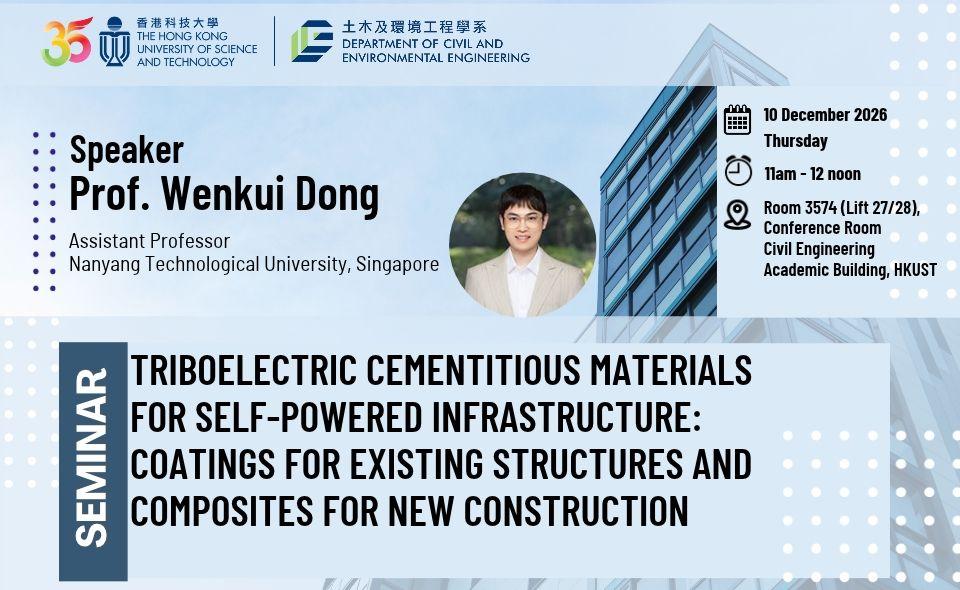
- Triboelectric Cementitious Materials for Self-Powered Infrastructure: Coatings for Existing Structures and Composites for New Construction
Supporting the below United Nations Sustainable Development Goals:支持以下聯合國可持續發展目標:支持以下联合国可持续发展目标:
Triboelectric Cementitious Materials for Self-Powered Infrastructure: Coatings for Existing Structures and Composites for New Construction
Cement-based triboelectric nanogenerator are revolutionizing smart civil infrastructure by integrating energy harvesting capabilities into traditional concrete. This seminar explores the development of high-performance triboelectric cementitious materials for self-powered infrastructure, covering two complementary approaches: functional cement-based coatings for existing structures and composites for new construction. For existing infrastructure, an polyurethane-cement coating incorporating CNTs is developed to enhance mechanical properties, interfacial charge retention, and triboelectric energy harvesting, while accommodating uneven and curved concrete surfaces. For new infrastructure, CB@SiO₂ core-shell nanofillers are introduced into cementitious matrices to tailor electrical and dielectric properties and improve triboelectric performance. These material design strategies offer promising opportunities for integrating energy harvesting functionalities into both existing and future infrastructure.
Dr. Wenkui Dong is an Assistant Professor at the School of Civil and Environmental Engineering, Nanyang Technological University, Singapore. He obtained his PhD from the University of Technology Sydney in 2022, followed by postdoctoral research at TU Dresden and UNSW Sydney. His research focuses on intelligent and sustainable construction materials for next-generation infrastructure, including self-sensing, energy-harvesting and storage, self-healing, and superhydrophobic cementitious systems. He has published over 100 SCI papers, received multiple academic awards, and served as an editorial board member/guest editor for several international journals. He has been recognized among the world's top 2% scientists from 2022 to 2026.