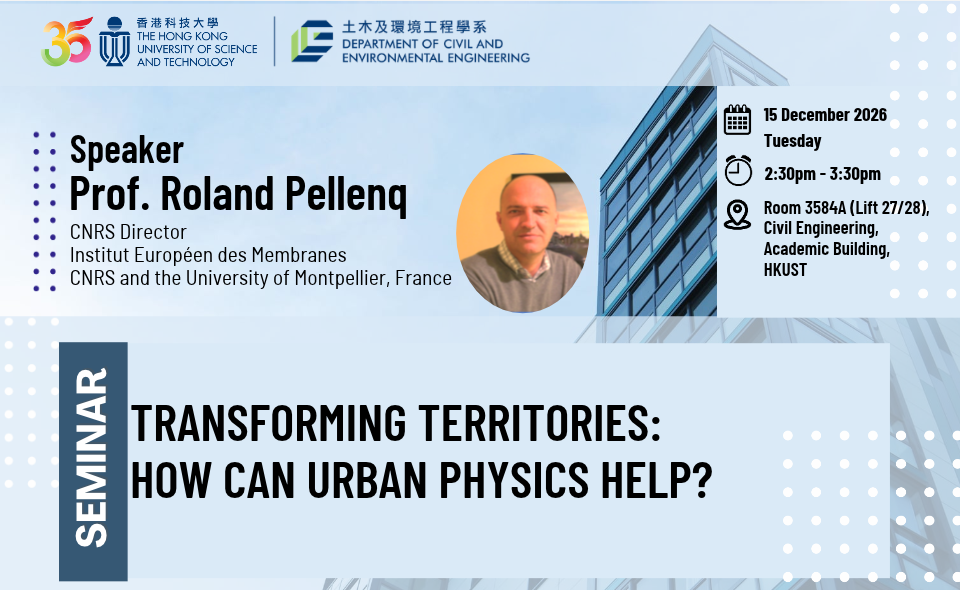
Civil Engineering Departmental Seminar - Transforming Territories: How Can Urban Physics Help?
Supporting the below United Nations Sustainable Development Goals:支持以下聯合國可持續發展目標:支持以下联合国可持续发展目标:
Transforming Territories: How Can Urban Physics Help?
Cities face growing pressures from climate change, including urban heat islands, sea-level rise, coastal erosion and flooding. Addressing these challenges requires moving beyond conventional urban planning towards an integrated, quantitative understanding of cities as complex physical systems. This is the ambition of Urban Physics. Urban Physics connects fundamental physics, materials science, computational modelling and urban observations to understand how construction materials, buildings and urban morphology interact with climate, energy and water cycles. At the material scale, research on the chemo-poro-mechanics of cementitious materials, porous carbons and advanced composites provides insights into ageing, degradation, water transport and durability, paving the way for more resilient and lower-carbon infrastructure.
At the urban scale, physical modelling combined observations, enables the characterization and prediction of urban microclimates, heat vulnerability and energy demand. Understanding the coupled effects of building materials, urban texture, vegetation and water, as well as rainfall, drainage and coastal dynamics, is essential to anticipating heat stress, flooding and sea-level rise. The ultimate ambition is to establish a predictive multiscale science of urban resilience, connecting molecular-scale processes to buildings and entire metropolitan territories. and provide decision-makers with tools to assess vulnerabilities, evaluate adaptation strategies and transform cities into more durable, sustainable and climate-resilient systems.
My contribution to this emerging field is to bring the conceptual and methodological foundations of fundamental physics, statistical mechanics and materials science into the understanding of cities as complex physical systems. My research trajectory, spanning molecular modelling, the chemo-poro-mechanics of disordered materials and the physics of construction materials, provides an opportunity to establish a continuous scientific framework linking processes at the molecular scale to the behavior of buildings, infrastructures and entire urban territories with the ultimate objective to move from describing urban vulnerabilities to predicting their evolution and evaluating scientifically grounded adaptation strategies, thereby making Urban Physics a key scientific driver of territorial resilience in the context of climate change.
Roland Pellenq is a CNRS Director of Research of Exceptional Class (DRCE1) at the European Institute of Membranes (CNRS and the University of Montpellier, France). He is a computational materials scientist with a strong interest in the physics of porous materials and confined fluids. He obtained a PhD in Chemical Physics from Imperial College London (UK) in 1994 and received a Habilitation degree from the University of Orléans (France) in 2000.
R. Pellenq's research is dedicated to the development of bottom-up simulation approaches for a large variety of critical problems in energy and environment, ranging from hydrogen/CH4 storage, CCUS, cement research and more recently to Urban Physics for the prediction of climate related risks in the urban environment (UHI, wind storms, pollution, flooding, airborne diseases…).
R. Pellenq is the author/co-author of 300+ papers and 1 patent on electron conduction carbon-cement composites. Since 2029, he is among the 0.6% most cited scientists (all disciplines considered, U. Stanford ranking). He was the founder and head of the Multiscale Materials Science for energy and Environment MIT-CNRS joint laboratory (2008-2020 as well as the co-founder of the CSHub@MIT, an industry sponsored laboratory on reducing cement and concrete industries carbon footprint).
R. Pellenq is the recipient of a number of international and national awards such as the 2024 Humboldt Foundation Research Award (Germany), the 2019 Prix Special du Jury, Trophées de l’Innovation from Aix-Marseille University (France), the 2018 Research Medal of the ALERT European Geomechanics association and the 2017 Appreciation award of the Engineering Mechanical Institute (US).