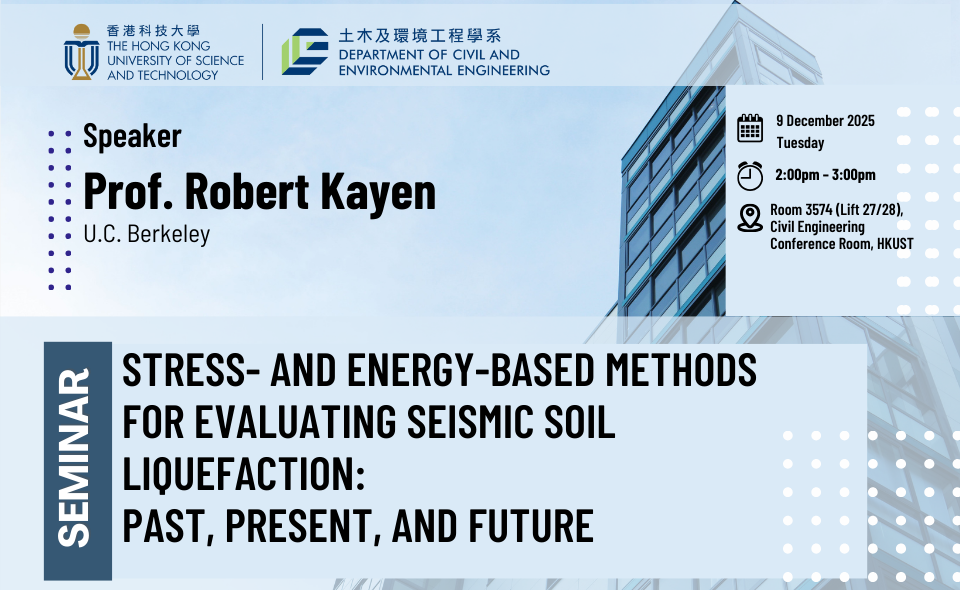
Civil Engineering Departmental Seminar - Stress- and Energy-based methods for evaluating seismic soil liquefaction: past, present, and future
Supporting the below United Nations Sustainable Development Goals:支持以下聯合國可持續發展目標:支持以下联合国可持续发展目标:
Stress- and Energy-based methods for evaluating seismic soil liquefaction: past, present, and future
This talk reviews recent work on cyclic stress and energy-based methodologies for estimating the demand-capacity state for initial soil liquefaction, the rise in pore water pressure, and the timing of soil liquefaction. Field methods, such as Standard Penetration Test (SPT), Cone Penetration Test (CPT), and shear-wave velocity (Vs), provide a means to determine soil's seismic resistance to liquefaction through routine field procedures, and, in the case of Vs, a fundamental soil property. This talk will present the results of a three-decade-long international project to gather site data and develop probabilistic correlations for seismic soil liquefaction triggering. The first correlations, published in 2004, 2006, and 2013, analyzed hundreds of sites from the literature and our acquisition of 310 Vs tests at sites in China, Japan, Taiwan, Greece, and the United States. We are updating these correlations and have expanded the data set to approximately 650 sites, mainly through new testing of the M9.0 2011 Tohoku Earthquake, Japan, and the 2011 Christchurch and 2010 Darfield Earthquakes, New Zealand. Bayesian regression and structural reliability methods facilitate a probabilistic treatment of the Vs catalog for performance-based engineering applications. Analysis of the uncertainties of the variables comprising both the seismic demand and the soil capacity is integral to the study and helps reduce overall model error.
Unlike stress-based methods, energy-based approaches use a scalar, cumulative parameter, making them well-suited for modeling pore pressure buildup and liquefaction onset. The rise in pore pressure and the onset of liquefaction can be estimated by summing the cumulative dissipated hysteretic energy normalized by the effective stress, which correlates strongly with the pore-pressure ratio ru. Energy dissipated beyond the liquefaction boundary maintains ru = 1.0. A key benefit of energy-based methods is improved estimation of liquefaction timing. These approaches aim to link total energy demand (Arias Intensity) to partially absorbed work ( dissipated energy).
Robert Kayen is a Professor in the Dept of Civil and Environmental Engineering at U.C. Berkeley, adjunct faculty. He teaches Engineering Geology, Extreme-event hazard and risk methods, and Engineering Geomatics. He recently retired from the United States Geological Survey after three decades as a research scientist. Kayen has a Ph.D. in Civil Engineering from U.C. Berkeley, a Master's degree in both Civil Engineering & Geology, and an Undergraduate degree in Civil Engineering from Tufts University. He is one of the founders and a long-time steering committee member of the National Science Foundation (NSF)-sponsored GEER (Geotechnical Extreme Events Reconnaissance Association; www.geerassociation.org). Kayen received honors, including the Thomas Middlebrooks Award from ASCE. Since 1989, he has led and participated in over thirty earthquake and extreme-event missions for the National Science Foundation and the USGS.