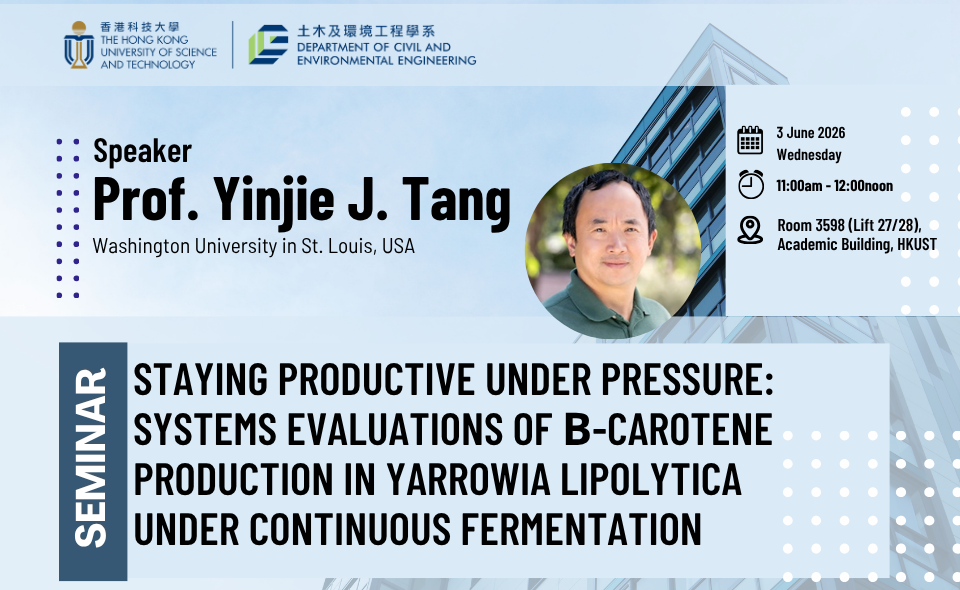
Civil Engineering Departmental Seminar - Staying productive under pressure: systems evaluations of β-carotene production in Yarrowia lipolytica under continuous fermentation
Supporting the below United Nations Sustainable Development Goals:支持以下聯合國可持續發展目標:支持以下联合国可持续发展目标:
Staying productive under pressure: systems evaluations of β-carotene production in Yarrowia lipolytica under continuous fermentation
The National Security Commission on Emerging Biotechnology (2025) identified executive priorities emphasizing resilience in the bioproduct supply chain. Over the past two decades, synthetic biology has greatly advanced the development of microbial cell factories. However, extensive pathway engineering and cellular modifications can impose unintended metabolic burdens, and suboptimal growth conditions in large bioreactors frequently trigger unanticipated physiological changes. As a result, cellular responses to intra- and extracellular perturbations remain poorly understood. Scaling microbial fermentation from laboratory to industrial production therefore continues to pose major challenges, particularly in maintaining strain stability during continuous operation. In this study, the Tang Lab and collaborators used a β-carotene producing Yarrowia lipolytica strain as a model to investigate key factors contributing to titer loss, focusing on bioreactor modes, carbon sources, oxygen availability, and media composition. Their results show that fermentation strategy and oxygen levels exert the strongest influence on strain stability, with production losses emerging within roughly 18 growth generations. Notably, oil-based carbon sources significantly improved both titer and production longevity relative to glucose-based media. To elucidate the mechanisms underlying titer loss, we integrated multi-omics analyses, cell imaging, 13C metabolic flux analysis, and kinetic modeling, revealing various contributions from metabolic regulation, subpopulation dynamics, and spontaneous mutations. The findings further suggest that strains engineered for maximal production under laboratory conditions may be less robust in industrial environments, where suboptimal yet faster-growing variants gain a competitive advantage under prolonged stress and ultimately dictate continuous industrial fermentation performance. This work has also catalyzed several new NSF supported projects in innovative biomanufacturing, integrating genetic-circuit engineering, AI/ML and large language models, and advanced bioprocess control. In my talk, I will also introduce the environmental and chemical engineering programs at Washington University in St. Louis. We warmly welcome MS and PhD applicants from The Hong Kong University of Science and Technology. We also offer the prestigious McDonnell International Scholars Academy fellowship to outstanding PhD students.
Professor Tang received his PhD in Chemical Engineering from the University of Washington and completed his postdoctoral training at Lawrence Berkeley National Laboratory. He joined the faculty of the School of Engineering at Washington University in 2008. His research focuses on applied environmental microbiology, AI/ML, metabolic analysis and modeling, and bioprocess engineering. Professor Tang serves as an Associate Editor for Biotechnology Advances, Biotechnology for Biofuels, Microbial Cell Factories, Frontiers in Microbiology, and Process Biochemistry. He is also a member of the Advisory Committee for the Predictive Phenomics Initiative at Pacific Northwest National Laboratory. His honors include the NSF CAREER Award (2010), the Ralph E. Powe Junior Faculty Enhancement Award (2010), the NSF Transition Award (2023), and the AIChE Division 15a Plenary Award (2024). His research program is currently supported by DOE, NSF, USDA, NASA, and DoD. At Washington University, he teaches Process Dynamics and Control, Bioprocess Engineering, and Generative AI for Bioengineering. He received the Department Chair’s Award for Outstanding Teaching in 2013.