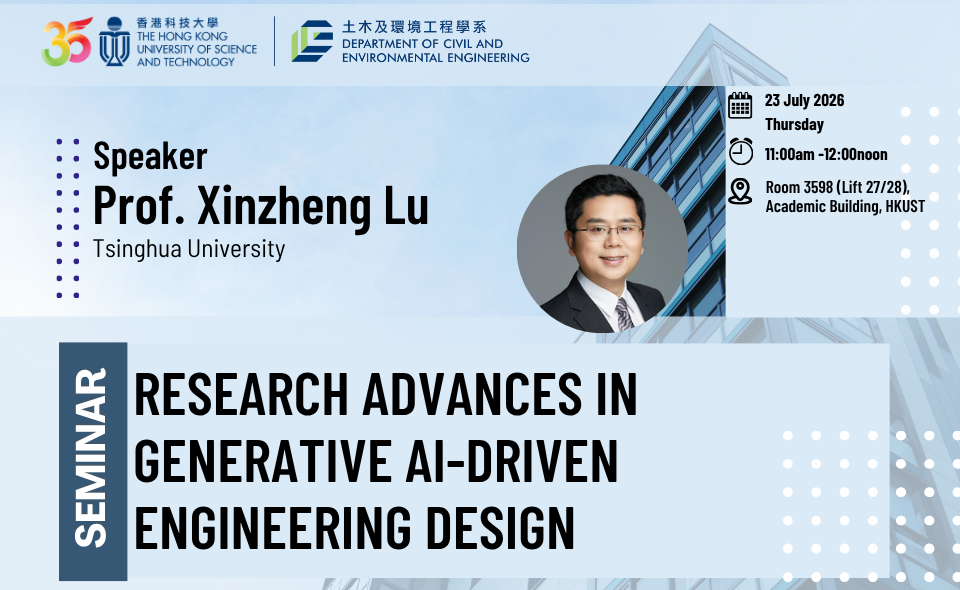
Civil Engineering Departmental Seminar - Research Advances in Generative AI-Driven Engineering Design
Supporting the below United Nations Sustainable Development Goals:支持以下聯合國可持續發展目標:支持以下联合国可持续发展目标:
Research Advances in Generative AI-Driven Engineering Design
Generative AI-driven intelligent engineering design constitutes a critical component of intelligent construction. To address the pain points of conventional engineering design, including heavy reliance on manual experience, high cross-disciplinary collaboration costs, and low efficiency of design iteration, this prestation will systematically introduce generative AI-enabled intelligent design methodologies and state-of-the-art applications across multiple engineering scenarios, including building structures, earth-rock dams, fire protection systems, bridges, and photovoltaic supports.
Based on diffusion models, generative adversarial networks (GANs), graph neural networks (GNNs), and multimodal large language models, the research proposes a data-knowledge-mechanics integrated learning framework. The framework embeds implicit empirical knowledge extracted from engineering drawings, design code constraints, and structural mechanical performance indicators into the generative workflow, enabling a closed-loop design pipeline that integrates schematic generation, performance verification, and optimization iteration.
For residential building structures, the system can automatically complete component layout, section sizing, and model generation. For earth-rock dams, it realizes dam zoning layout and stability evaluation. Engineering case studies demonstrate that AI-generated design schemes are comparable to expert-level designs and meet the requirements of preliminary design. The proposed approach significantly improves design efficiency, code compliance, and structural safety.
Prof. Xinzheng Lu got his BS and Ph.D. degrees from Tsinghua University of China. Now he is a full professor and the Head of the Institute of Disaster Prevention and Mitigation of the Department of Civil Engineering at Tsinghua University. He also serves as Editor of Earthquake Engineering & Structural Dynamics, among other academic appointments.
Prof. Lu’s major research interests cover intelligent design of civil engineering, and disaster prevention and mitigation. He has published more than 200 international journal papers and eight books, and his publications have received over 20,000 citations. He has been listed as one of the “most cited Chinese researchers from 2014-2025” by Elsevier. His research outcomes have been adopted by Chinese and international design codes, major disaster simulation systems, and structural calculation software, and have been applied to many landmark projects. He delivered multiple keynote presentations at significant international conferences, including the 18th World Conference on Earthquake Engineering. He has received several important awards, including the Second Class National Natural Science Award, the First-Class Science and Technology Progress Award of Beijing (first contributor), the First-Class Natural Science Award of Ministry of Education of China (first contributor), the Distinguished Professor of the Chang Jiang Scholars Program, the XPLORER PRIZE of the Tencent Foundation, Gold Award with congratulations of the jury of International Exhibition of Inventions of Geneva, and the J. M. Ko Award.