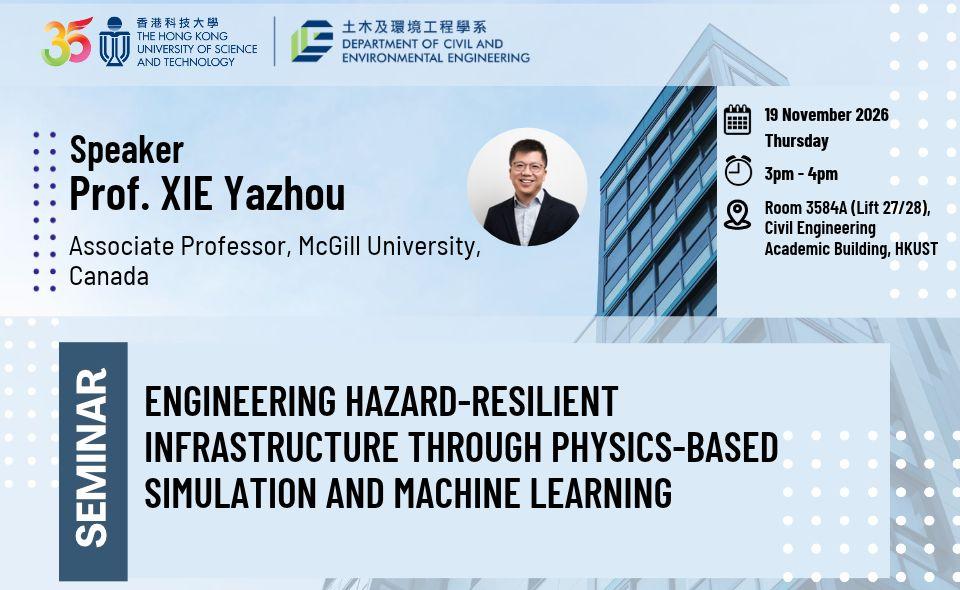
Civil Engineering Departmental Seminar - Engineering Hazard-Resilient Infrastructure through Physics-based Simulation and Machine Learning
- Engineering Hazard-Resilient Infrastructure through Physics-based Simulation and Machine Learning
Supporting the below United Nations Sustainable Development Goals:支持以下聯合國可持續發展目標:支持以下联合国可持续发展目标:
Engineering Hazard-Resilient Infrastructure through Physics-based Simulation and Machine Learning
This seminar presents recent research advances from the Hazard Mitigation & Infrastructure Resilience (HMIR) Lab at McGill. The topics covered include aftershock hazard evolution, regional seismic risk assessment, and machine learning applications in natural hazards engineering. First, using the Cascadia Subduction Zone megathrust earthquake as a case study, aftershock hazards are simulated to explicitly account for the temporal dependence and stochastic nature of mainshock–aftershock sequences. A Markov chain model is further employed to characterize the evolution of structural damage under successive aftershocks. Second, leveraging second-generation component-level seismic fragility models for California bridges, a refined framework is established to estimate component-level repair costs and functional recovery. The framework is utilized for high-resolution seismic loss assessment of the Los Angeles bridge network. The presentation further showcases recent developments in statistical and deep learning surrogate models for innovative applications in earthquake and multi-hazards engineering. Collectively, these advances enhance modelling fidelity, resolution, computational efficiency, and uncertainty quantification towards next-generation assessment and design of multi-hazard resilient infrastructure.
Dr. Yazhou (Tim) Xie is an Associate Professor and William Dawson Scholar in the Department of Civil Engineering at McGill University. He directs the HMIR Lab at McGill. Xie received his B.Eng. and M.Sc. degrees from Tongji University, followed by a Ph.D. from the University of California, Los Angeles (UCLA). He then worked as a Postdoctoral Research Associate at Rice University. Dr. Xie's research focuses on seismic resilience, multi-hazard risk, and the innovative application of AI. He has published more than 70 papers in leading journals and has led over 20 competitively funded research projects. Dr. Xie has received several honors and awards, including the 2017 UCLA Dissertation Year Fellowship Award and the 2023 Engineering Class of 1944 Teaching Award. Xie currently serves as an Associate Editor for ASCE OPEN: Multidisciplinary Journal of Civil Engineering and Earthquake Spectra. Xie is also a member of the technical committee for CSA S6:30, Canadian Highway Bridge Design Code.