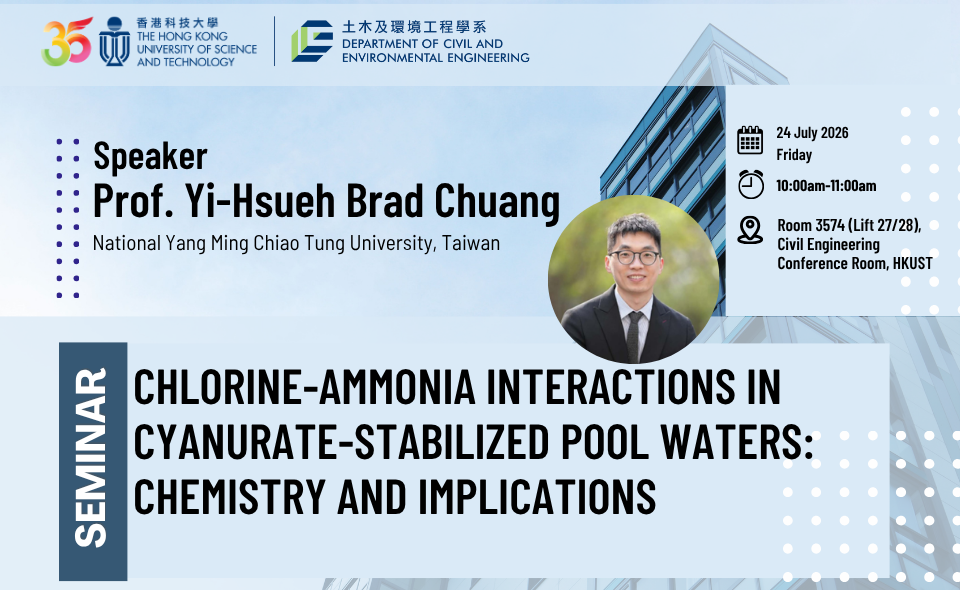
Civil Engineering Departmental Seminar - Chlorine-Ammonia Interactions in Cyanurate-Stabilized Pool Waters: Chemistry and Implications
Supporting the below United Nations Sustainable Development Goals:支持以下聯合國可持續發展目標:支持以下联合国可持续发展目标:
Chlorine-Ammonia Interactions in Cyanurate-Stabilized Pool Waters: Chemistry and Implications
National Yang Ming Chiao Tung University, Taiwan Outdoor swimming pools commonly use cyanuric acid to stabilize free chlorine against photolysis. While this practice improves chlorine persistence, it also reshapes chlorine–ammonia chemistry in pool water, where ammonia and organic nitrogen are continuously introduced by swimmers. This presentation examines how cyanuric acid alters breakpoint chlorination pathways and the associated balance between contaminant oxidation and nitrogenous disinfection byproduct formation.
Our results show that cyanuric acid changes free-chlorine speciation by reversibly forming chlorinated cyanurates, making chlorine reactivity strongly dependent on cyanurate equilibria. More importantly, chlorinated cyanurates are not merely passive chlorine reservoirs; they can participate directly in chloramine transformation by chlorinating monochloramine and dichloramine, although more slowly than HOCl. These reactions prolong chloramine cycling and influence the formation and decay of trichloramine.
Under simulated pool-water conditions, cyanuric acid suppressed residual trichloramine accumulation but enhanced trace contaminant removals, consistent with sustained hydroxyl radical production through NCl3–NHCl2 interactions. However, cyanuric acid also promoted nitrosamine formation, indicating that lower trichloramine residuals do not necessarily correspond to lower nitrogenous byproduct risk. Overall, this work highlights cyanuric acid as an active regulator of pool-water reaction pathways, not simply a chlorine stabilizer.
Yi-Hsueh Brad Chuang is an Associate Professor at the Institute of Environmental Engineering at National Yang Ming Chiao Tung University. He earned his Bachelor of Science in Environmental Engineering from National Cheng Kung University in 2007 and completed his Ph.D. in Environmental Engineering at National Taiwan University in 2013. Following his doctoral studies, Dr. Chuang undertook a postdoctoral fellowship at Stanford University, where he worked from 2014 to 2019.
Dr. Chuang's research interests include potable reuse, environmental chemistry, disinfection byproduct formation, and advanced oxidation processes. His work is driven by a commitment to advancing sustainable environmental practices and developing innovative solutions for water treatment and reuse. In recent years, his research has focused on the mechanistic chemistry of breakpoint chlorination, particularly the formation of N-nitrosamines and reactive radical species from inorganic chloramine reactions. His recent works have advanced understanding of how trichloramine–dichloramine interactions contribute to nitrosamine formation and how cyanuric acid, a common chlorine stabilizer in swimming pools, reshapes chlorine–ammonia chemistry, radical production, and disinfection byproduct risks.