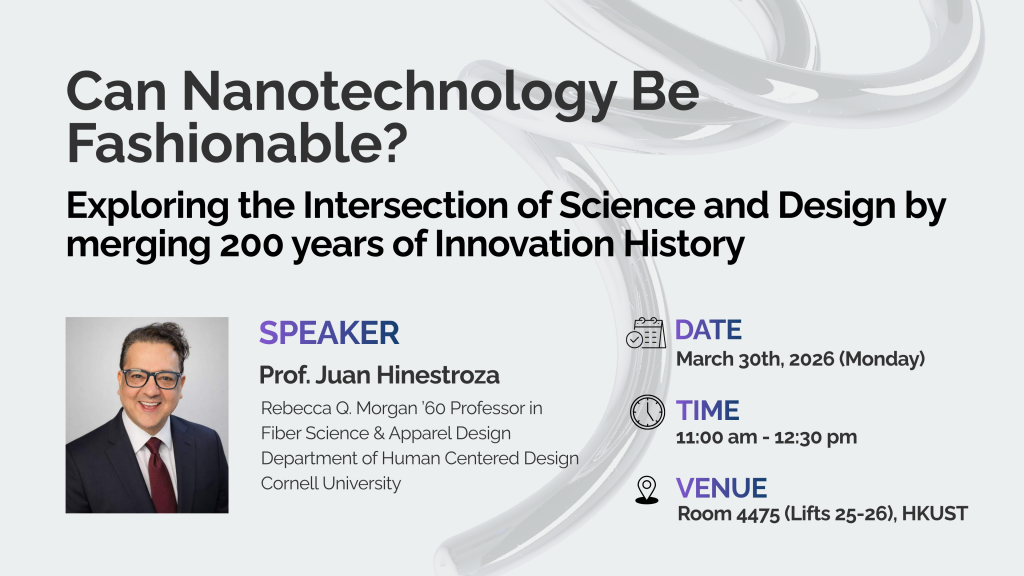
Can Nanotechnology Be Fashionable? Exploring the Intersection of Science and Design by merging 200 years of Innovation History
Supporting the below United Nations Sustainable Development Goals:支持以下聯合國可持續發展目標:支持以下联合国可持续发展目标:
Textiles are among humanity’s oldest technologies. For thousands of years, fibers and fabrics have been woven into everyday life, culture, and industry. The textile sector was also one of the earliest beneficiaries of the scientific advances that powered the Industrial Revolution more than two centuries ago. Today, a new wave of scientific tools such as advanced instrumentation, computing, and nanoscale engineering have opened the door to another transformation: the integration of nanoscale science with textiles.
Our research work has explored this unexpected intersection between one of the world’s oldest material platforms and one of the newest scientific frontiers in materials science. By combining the precision of nanoscale science with the reliable manufacturing methods developed by the textile industry, we can now design fabrics with entirely new capabilities.
At the heart of this work is cotton, a natural fiber made from cellulose, the most abundant polymer on Earth, and a material that has been worn next to the human body for more than 6,000 years. By engineering cotton at the nanoscale, our group has developed fabrics that conduct electricity, change color, selectively filter chemicals, and even sense biomarkers from human sweat. Cotton can also serve as a versatile scaffold for advanced materials such as nanoparticles, nanorods, metal–organic frameworks, and ultra-thin functional coatings.
Textiles are never only about materials; they are also about design. Working in a field that bridges fiber science and apparel design has allowed us to approach chemistry and materials engineering through the lens of design creativity. This unusual environment has shown us that exposure to design can help science students become better engineers, while also opening new scientific possibilities for the imaginative minds of design students.
Beyond publications, patents, and start-ups, this work demonstrates how fashion and design can also serve as powerful vehicles for communicating science. By blending creativity with nanotechnology, we can inspire new audiences, especially younger generations, to see science not only as a technical pursuit, but also as a medium for imagination and innovation.
Juan P. Hinestroza, a U.S. Fulbright Scholar and a PMP®, is the Rebecca Q. Morgan ’60 Professor in Fiber Science & Apparel Design and directs The Textiles Nanotechnology Laboratory in the Department of Human-Centered Design at Cornell University in Ithaca, NY.
Hinestroza has experience in diverse research and teaching ecosystems including academia, the military, non-profit organizations, start-up companies as well as large corporations. Hinestroza has worked at institutions in Asia, the Middle East, Europe, as well as South and North America.
Hinestroza is inventor of more than 61 granted international patents; author of over 125 peer-reviewed articles and 7 book chapters; and editor of a book on cellulose-based green composites. Hinestroza’s pioneering scientific work has enabled the creation of 3 start-up companies, and he has served as a consultant to major Fortune 500 corporations, private equity funds and investment banks in the field of smart and interactive textiles and fibers.
Hinestroza obtained a Ph.D. from the Department of Chemical and Biomolecular Engineering at Tulane University and B.Sc. in Chemical Engineering from Universidad Industrial de Santander. Prior to pursuing doctoral studies, he worked as a process control engineer for The Dow Chemical Company.