[Call for Abstracts] APRU Sustainable Cities and Landscape Conference 2027
Supporting the below United Nations Sustainable Development Goals:支持以下聯合國可持續發展目標:支持以下联合国可持续发展目标:


The 10th edition of APRU Sustainable Cities and Landscapes (SCL) Conference 2027 to be hosted by the Department of Architecture at the National University of Singapore from May 21 to 23, 2027 is calling for abstracts.
Amid climate change, economic and technological uncertainties, and social and environmental disruptions, cities and communities across the Pacific Rim are facing profound and unprecedented challenges. In addressing these challenges, however, the knowledge and practices of sustainable planning, governance, and design often remain siloed and fragmented.
Themed "Bridging Resilience(s)", the conference will explore how different knowledge and practices can connect and coalesce in advancing social, cultural, and environmental resilience in cities and communities. It will further examine how bridging itself- the ability to network, organize, co-create, and forge connections - can represent a form of resilience in the face of crisis and disruption. Singapore, with its unique institutional structure along with the challenges of density and land scarcity, provides a setting for this discussion.
The conference in 2027 will celebrate the 10th anniversary of the growing network of scholars, educators, practitioners, and community partners in the Pacific Rim.
Members of HKUST are welcome to submit papers, posters, and panel proposals that examine critical issues and emerging strategies for urban and environmental resilience across the Pacific Rim. Contributions may engage with these topics through transdisciplinary collaboration, comparative studies, and cross-cultural investigation. Accepted paper and poster presentations will be eligible for consideration for the Best Paper and Best Poster Awards, respectively, in recognition of outstanding contributions to the conference.
Please submit your abstract for an oral/poster presentation in tracks including, but not limited to:
Track 1 AI for resilience
Track 2 Human–nature interactions and health implications
Track 3 Environmental, economic, and social infrastructure
Track 4 Climate justice
Track 5 Botanic and agricultural urbanism
Track 6 Urban landscape biodiversity
Track 7 Water, seascapes, and infrastructure
Track 8 Energy landscapes and systems
Track 9 Community engagement and co-design
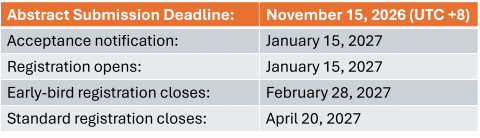
Key Dates: