APRU Mini Certificate in Health Research Ethics - APRU Mini Certificate in Health Research Ethics
Supporting the below United Nations Sustainable Development Goals:支持以下聯合國可持續發展目標:支持以下联合国可持续发展目标:
Overview
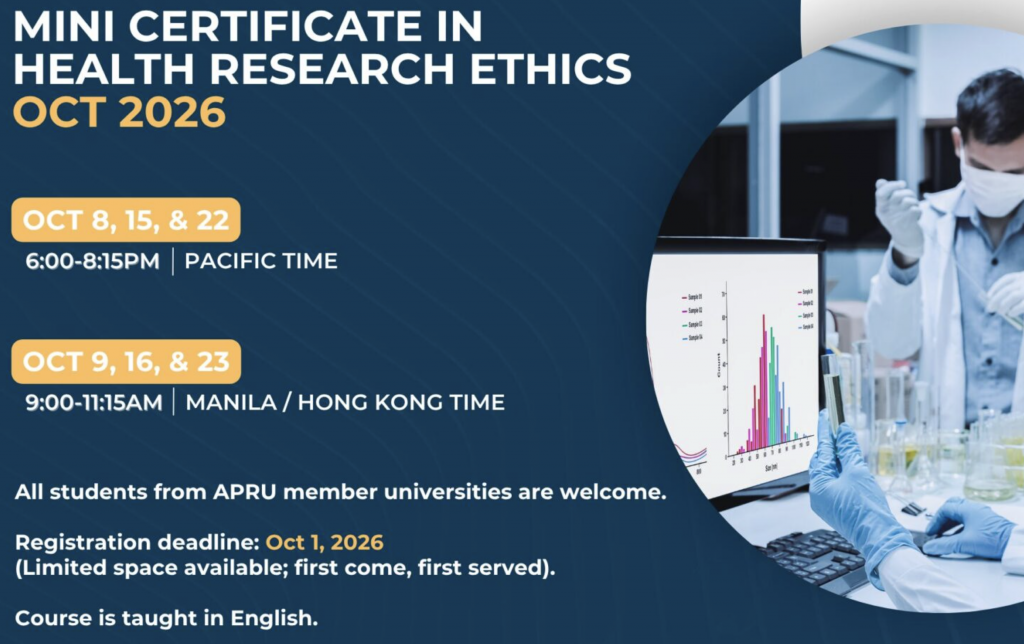
The APRU Global Health Mini Certificate in Health Research Ethics is a free virtual and interactive training designed for students with limited backgrounds in research ethics. Join students from around the world to develop competencies to conduct ethical health research.
The course includes lectures delivered in English by international guest speakers, as well as small-group case study discussions led by expert faculty from more than 10 economies. The course requires a total of 10 hours of study, including online homework.
Background
Proper training in the conduct of ethics involved in medical and health research with human subjects is to ensuring that students conduct research ethically. However, some universities in the Asia-Pacific region do not incorporate ethics training as part of their public health curricula. Meanwhile, the pandemic has forced most of the world’s higher education institutions to conduct teaching, research, and learning activities remotely.
This mini certificate training is offered by the APRU Global Health Working Group on Bioethics.
Learning Objectives
- Outline the main principles that guide the ethical conduct of research with human subjects
- Describe some of the historical cases of unethical research with human subjects which have led to the need for more human subject protection.
- Explain the importance of community participation in health research
- Analyze real-world cases of ethical challenges in health research
- Describe best practices in ethical health research and practice to protect human subjects
- Identify major documents, protocol and systems in place to ensure adherence to ethical principles in health research.
- Discuss the function of IRB/RECs
Monique Jonas is an ethical theorist based at the School of Population Health at the University of Auckland, New Zealand. She has a Doctorate in Medical Ethics from Kings College London. Her current research focuses on the ethics of advising, ethical aspects of parenting and decision making for children and the relationship between the family and the state. Monique is the Chair of the Health Research Council Ethics Committee and has served on the National Ethics Advisory Committee and the National Health Committee in New Zealand.
Dr. Bridget Haire is a senior research fellow at the Kirby Institute, University of NSW and an associate of the Australian Human Rights Institute. She is trained in bioethics, and conducts research in the areas of research ethics, public health, sexual health and infectious diseases. Bridget also convenes UNSW’s research ethics panel on health, medical, community and social research. She has published extensively on HIV prevention, and is a former president of Australia’s peak body for the community response to HIV. She is committed to conducting research in partnership with affected communities. Bridget has also published on the ethical issues in the control of Ebola and COVID-19. Her recent COVID-19 related research includes a study on the impacts of hotel quarantine, an evaluation of the COVIDSafe App and the human rights implications of vaccine mandates and passports.
Sharon Kaur (LLB, MA, PhD) is a Senior Lecturer at the Faculty of Law, Universiti Malaya, where she has designed modules on healthcare law and ethics for undergraduate as well as postgraduate students. She also teaches on the Masters of Health Research Ethics (MOHRE) programme at the Faculty of Medicine, University of Malaya. Her research interests primarily revolved around medical research ethics and issues relating to the rights of marginalised populations. She is currently working on a number of projects related to the COVID-19 pandemic, one of which relates to the challenges of data sharing in a middle-income country. Her postgraduate training was in Medical Law and Medical Ethics and her doctoral thesis addressed the role of research ethics committees in relation to clinical trials involving mentally incapacitated adults.
Nina T. Castillo-Carandang MA, MSc, PhD is a professor of health sociology and global health; and is the Chair of the Department of Clinical Epidemiology, College of Medicine, University of the Philippines Manila (UPM). Professor Castillo-Carandang also has academic qualifications in clinical epidemiology and health social science. She is an active researcher on Kagalingan (wellbeing), and the sociocultural dimensions of health and health care; and is also a member of the UPM Research Ethics Board.
Ricardo A. Peña Silva, MD, PhD is an associate professor at Universidad de los Andes Faculty of Medicine. He is a pharmacologist with a passion for biomedical research and education. Since the age of 16, he has been actively involved in education, from secondary school to postgraduate education in the health sciences, and engaged in biomedical research exploring the effects of aging and inflammation on cerebrovascular and cardiovascular disease.
He has worked in higher education administration, in the accreditation of academic programs, and managed research productivity programs. Three personal observations orient his interests in education and research: 1) All countries have talented people. Managing opportunities to exploit those talents is key to human and economic development. 2) Developing countries have significant functional literacy problems that impact subjects’ performance, regardless of their academic training level. The functional illiteracy in a segment of the population also makes them more susceptible to poor health outcomes. 3) Critical and innovative thinking, fostered by education and research, is key to the growth of communities, institutions, and health systems. The accelerated changes brought about by information technologies and the industrial revolution 4.0 can shrink the productivity gap between developing and developed countries if properly managed and implemented.
Professor Mellissa Withers @ mwithers@usc.edu