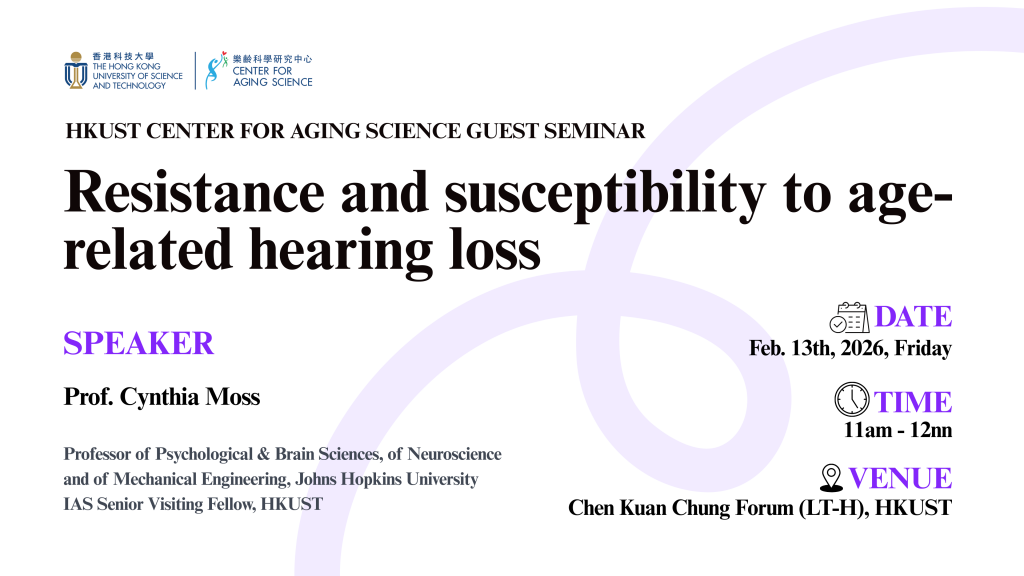
Center for Aging Science Guest Seminar - Resistance and Susceptibility to Age-Related Hearing Loss
Supporting the below United Nations Sustainable Development Goals:支持以下聯合國可持續發展目標:支持以下联合国可持续发展目标:
Noise-induced and age-related hearing loss are increasingly common sensory deficits that arise from an interaction of genetic susceptibility and environmental exposures. Much work has focused on uncovering the mechanisms that increase susceptibility to hearing loss, but few studies have explored innate mechanisms that protect against hearing loss. We are now employing bats as research models to probe innate resistance and susceptibility to noise-induced and age-related hearing loss.
Echolocating bats offer a unique opportunity to investigate natural resistance to hearing loss. Many bat species inhabit extremely noisy environments, often roosting in dense colonies where sound levels can reach 110–140 dB SPL, and they rely on acute hearing throughout their lives for navigation, foraging, and obstacle avoidance. Remarkably, bats are also exceptionally long-lived for their size, frequently surviving 20–30 years or more, yet show little evidence of hearing decline despite lifelong exposure to intense acoustic stimulation.
Recent work combining DNA methylation–based age estimation with auditory brainstem response (ABR), distortion product otoacoustic emission (DPOAE), and histological analyses reveals minimal evidence of cochlear or functional hearing decline in aging big brown bats. Hearing thresholds, neural responses, and cochlear structures remain comparable between young and older individuals, suggesting that bats possess protective mechanisms that preserve auditory function well into advanced age. Understanding the mechanisms that support robust auditory function in bats across prolonged lifespans and extreme acoustic exposure may reveal strategies to prevent or slow hearing loss in humans. These insights could ultimately guide development of interventions to preserve hearing health in aging and noise-exposed populations.
Cynthia F. Moss is Professor of Psychological and Brain Sciences, with joint appointments in Neuroscience and Mechanical Engineering. At Johns Hopkins, she directs the Comparative Neural Systems and Behavior Laboratory, aka the Bat Lab. Moss received a B.S. (summa cum laude) from the University of Massachusetts, Amherst and a Ph.D. from Brown University. She was a Postdoctoral Fellow at the University of Tübingen, Germany, and a Research Fellow at Brown University before joining the faculty at Harvard University. At Harvard, Moss received the Phi Beta Kappa teaching award and was named the Morris Kahn Associate Professor. She also received the National Science Foundation Young Investigator Award. She later moved to the University of Maryland, where she was a Professor in the Department of Psychology and Institute for Systems Research. At Maryland, Moss served as Director of the interdepartmental graduate program in Neuroscience and Cognitive Science. She was recognized in 2010 with the University of Maryland Regents Faculty Award for Research and Creativity. In 2014, Moss joined the faculty at Johns Hopkins University, where she enjoys teaching and research collaborations with students, postdocs and faculty in the Krieger School of Arts and Sciences, Whiting School of Engineering, and the School of Medicine. Her recent awards include the Hartmann Award in Auditory Neuroscience (2017), the James McKeen Cattell Award (2018) and the Alexander von Humboldt Research Prize (2019). She is a Fellow of the American Association for the Advancement of Science, the Acoustical Society of America and the International Society for Neuroethology.