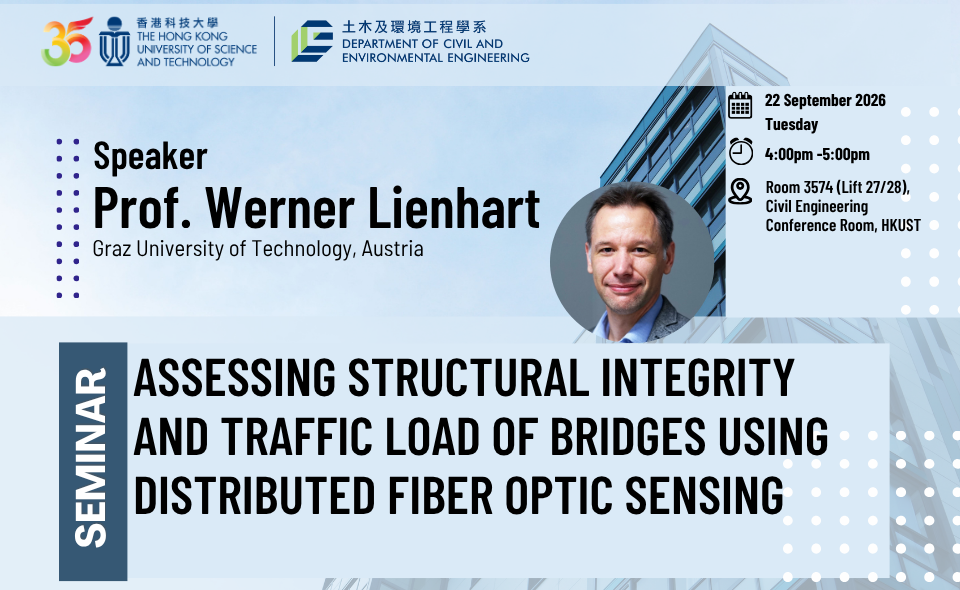
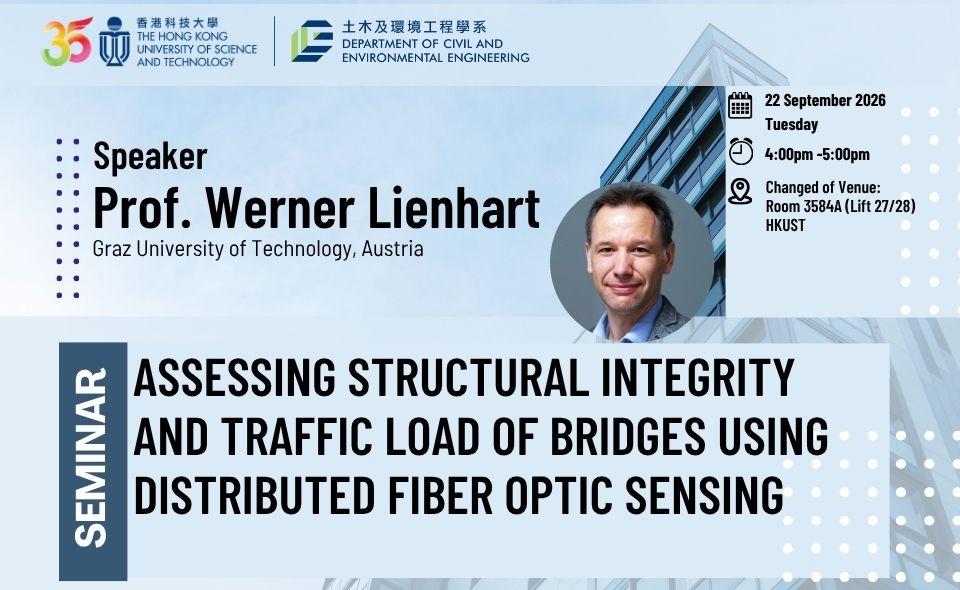
Civil Engineering Departmental Seminar - Assessing structural integrity and traffic load of bridges using distributed fiber optic sensing
Supporting the below United Nations Sustainable Development Goals:支持以下聯合國可持續發展目標:支持以下联合国可持续发展目标:
Assessing structural integrity and traffic load of bridges using distributed fiber optic sensing
Many developed countries face the challenge of aging bridges. Due to the intensive bridge construction work in the 1960s and 1970s a large number of structures is approaching the end of their service life. Structural Health Monitoring (SHM) offers a means to keep these structures safely in operation.
Distributed Fiber Optic Sensing (DFOS) plays a central role in modern SHM systems. Its distributed measurement capability enables the detection of concrete cracking and tension wire breaks, while also allowing assessment of bending behaviour of bridge spans.
This talk presents real-world case studies from existing and newly constructed bridges in Austria, Switzerland and Germany, illustrating both the challenges and opportunities of high-resolution Distributed Strain Sensing (DSS) and Distributed Acoustic Sensing (DAS). The discussion covers installation considerations, data acquisition methods and automated processing routines using Machine Learning (ML). The results demonstrate that DFOS measurements can assess structural integrity and quantify vehicle traffic on bridges.
The talk also introduces the “birth certificate” concept for bridges - an intensively discussed idea in Central Europe - whose purpose is to establish a baseline dataset to support future investigations.
Finally, lab investigations provide a clear picture of limitations of the dynamic range of commercially available DFOS interrogators. Strategies on how to overcome these limitations are discussed in this talk.
Werner Lienhart is Full Professor and Head of the Institute of Engineering Geodesy and Measurement Systems (IGMS) at Graz University of Technology, Austria. At IGMS Werner and his team develop new geodetic, fibre optic and IoT sensors for Structural Health Monitoring (SHM).
Prior to his university position, Prof. Lienhart was product manager at Leica Geosystems at the headquarter in Switzerland. At Leica he was responsible for the development of the Galileo and GPS L5 capable receivers and the Leica imaging total stations.
Now at TU Graz Prof. Lienhart leads the IGMS measurement lab, where several specific calibration facilities were set up for the calibration of fibre optic sensors as well as for the testing of total stations and laser scanners. He has more than 25 years of experience in practical applications of SHM. Prof. Lienhart and his team have installed and are currently responsible for the operation of several monitoring systems of long railway and highway tunnels as well as the monitoring of water dams, bridge, gas pipelines, reinforced earth structures and landslides.
Prof. Lienhart has published more than 200 scientific articles, holds several patents, is President of the Austrian Geodetic Commission (OeGK), chair of Commission 6 of the International Federation of Surveyors (FIG) and co-founder of ACI Monitoring, a company specialized in fibre optic sensing in civil engineering and geotechnical applications.