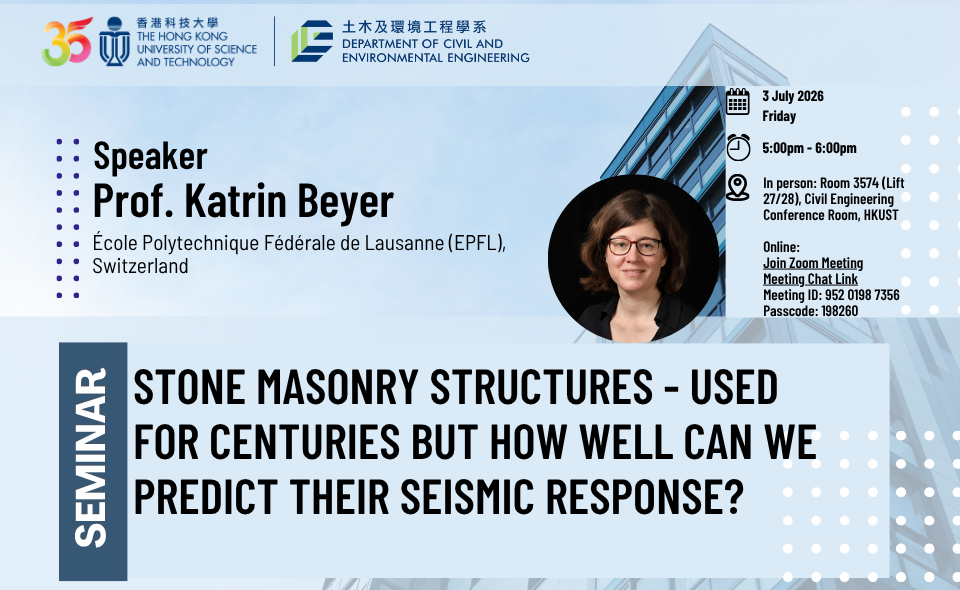
Civil Engineering Departmental Seminar - Stone masonry structures - used for centuries but how well can we predict their seismic response?
Supporting the below United Nations Sustainable Development Goals:支持以下聯合國可持續發展目標:支持以下联合国可持续发展目标:
Stone masonry structures - used for centuries but how well can we predict their seismic response?
In Europe, stone masonry structures are a heritage of the past while in many regions around the world stone is used as a cheap and readily available construction material for informal constructions. In addition, stone could also be of interest for new, engineered and sustainable structures of few stories. However, stone masonry structures are typically very vulnerable to seismic forces and often responsible for a large ratio of the death toll in an earthquake. It is therefore crucial to understand what: What are the factors that influence the seismic response of stone masonry buildings and how well can we actually predict their seismic response?
This presentation will cover recent and ongoing research conducted at the Earthquake Engineering and Structural Dynamics Laboratory at EPFL. The work spans multiple scales, from experimental studies on wall-mortar interactions at the material level to the performance of entire masonry buildings under seismic conditions. It discussed key structural features that influence the seismic response of stone masonry structure and the current state of our ability to predict the seismic response of masonry structures as well as open challenges.
Katrin Beyer is Full Professor at the École Polytechnique Fédérale de Lausanne (EPFL), Switzerland, where she heads the Earthquake Engineering and Structural Dynamics Laboratory (EESD). After completing her studies in civil engineering at ETH Zurich, she worked at ARUP in London on projects involving structural dynamics, impact engineering, and seismic analysis. She received her PhD in Earthquake Engineering from the University of Pavia, Italy.
Her research focuses on the seismic behaviour of unreinforced masonry structures, combining experimental testing and numerical modelling. A strong advocate of open science, she promotes the sharing of research data and models through open-access platforms. She serves on the Executive Committee of the European Association for Earthquake Engineering and led the revision of the masonry provisions in Eurocode 8 Part 1. Since 2024, she has served as Dean of the School of Architecture, Civil and Environmental Engineering (ENAC) at EPFL.
Join Zoom Meeting
Meeting Chat Link
Meeting ID: 952 0198 7356
Passcode: 198260