Civil Engineering Departmental Seminar - Advancing Next-Generation Construction Materials: A Cementless System with One-Third the CO₂ Emissions of UHPC
Supporting the below United Nations Sustainable Development Goals:支持以下聯合國可持續發展目標:支持以下联合国可持续发展目标:
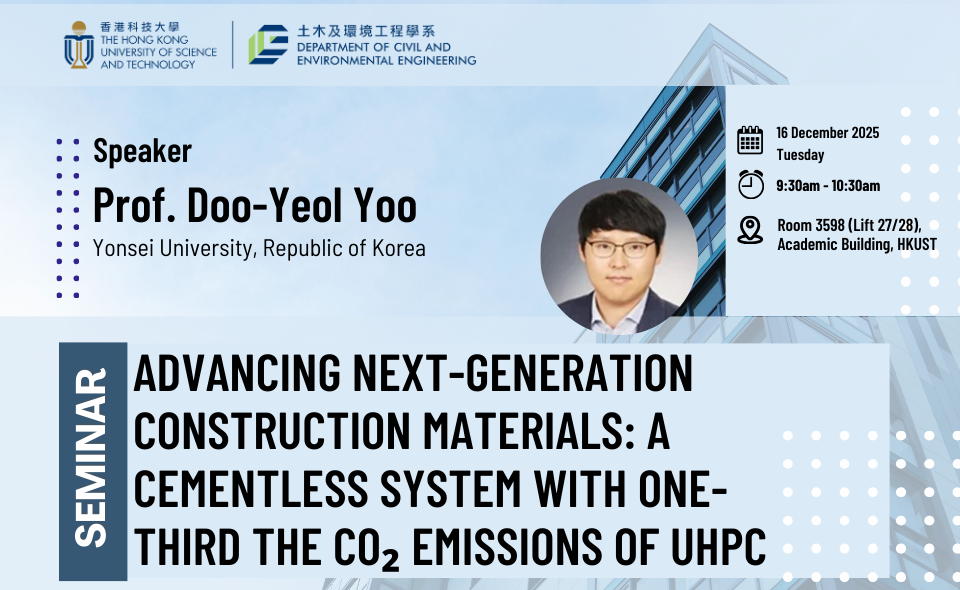
Advancing Next-Generation Construction Materials: A Cementless System with One-Third the CO₂ Emissions of UHPC
Ultra-high-performance concrete (UHPC) has become indispensable in modern infrastructure owing to their exceptional strength, ductility, and durability. However, its heavy dependence on Portland cement results in considerable carbon emissions, posing a significant challenge to national and global carbon-neutrality goals. This seminar introduces a cement-free ultra-high-performance composite system that utilizes a Ca-based activator in combination with ground granulated blast-furnace slag (GGBFS), achieving roughly a one-third reduction in CO₂ emissions while retaining the performance levels associated with conventional UHPC.
The presentation begins with an assessment of the carbon footprints of UHPC, highlighting the dominant contribution of cement production to their overall environmental impact and underscoring the need for alternative binder systems. It then discusses the development of a next-generation alkali-activated matrix that employs Ca-rich industrial by-products as the principal activator, offering a means to overcome several limitations observed in sodium- or potassium-based systems. Experimental findings from compressive and direct tensile tests, supported by DIC-based crack analysis, demonstrate that the proposed system achieves stable strain-hardening behavior with controlled multiple microcracking while delivering ultra-high mechanical performance.
Overall, the study aims to present a new direction for future construction materials by showing how re-engineering binder chemistry can substantially reduce carbon emissions without compromising structural performance.
Prof Doo-Yeol Yoo is a Professor in the Department of Architecture and Architectural Engineering at Yonsei University and an Affiliate Professor in the Department of Civil Engineering at the University of British Columbia
He received his B.S. in 2008 and Ph.D. in 2014 from Korea University and subsequently completed his postdoctoral training at the University of British Columbia. Prior to his current appointment, he served as an Associate Professor at Hanyang University. His current research interests include Ultra-High-Performance Fiber-Reinforced Concrete (UHPFRC), cement-free binders, CO₂-sequestering concrete, and multifunctional cementitious composites.
As of 2025, he has published over 290 journal papers, accumulating more than 15,917 citations and an h-index of 69 (Scopus). He has led 29 competitive research projects with total funding exceeding USD 3.9 million and holds 12 domestic patents. His scholarly impact is evidenced by his receipt of the Wason Medal from the American Concrete Institute (ACI) in 2025, election as a Fellow of the IAAM, inclusion in the World’s Top 2% Scientists list (Stanford University, 2021–2023), the Presidential Young Scientist Award of Korea, and his global ranking of 53rd in the Building & Construction field by c-score (Elsevier).
He has served on the organizing and technical committees of several international conferences and currently holds editorial roles as an Associate Editor for the Alexandria Engineering Journal and as an editorial board member for several leading journals, including Cement and Concrete Composites, Scientific Reports, and npj Materials Sustainability, among others.