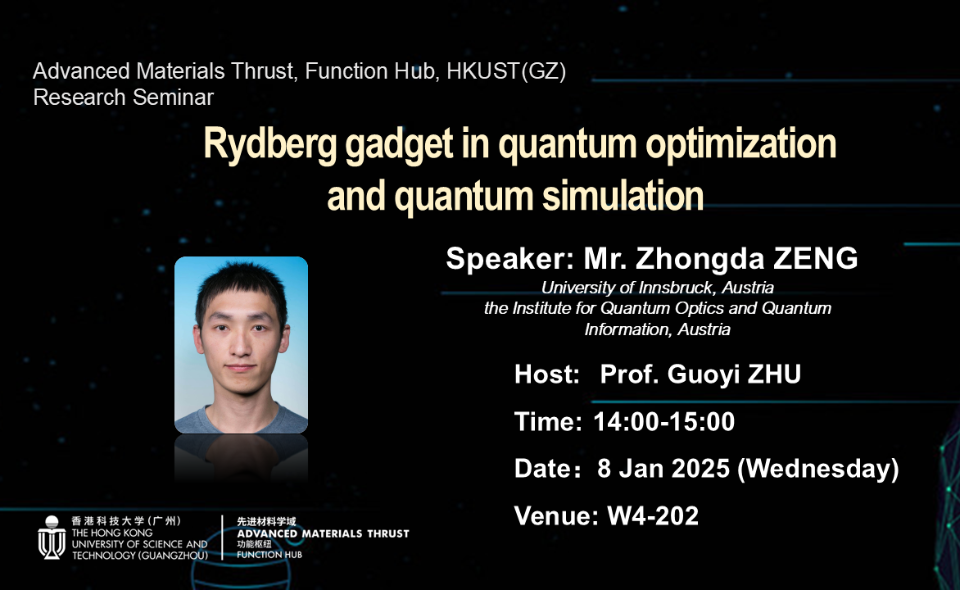
Public Research Seminar by Advanced Materials (AMAT) Thrust, HKUST(GZ) - Rydberg gadget in quantum optimization and quantum simulation
Supporting the below United Nations Sustainable Development Goals:支持以下聯合國可持續發展目標:支持以下联合国可持续发展目标:
Rydberg atom arrays have advanced significantly in simulating large and complex systems, but their application remains constrained by the specific class of problems they can naturally encode. In this talk, I will present two applications of Rydberg gadgets—clusters of atoms designed to impose flexible local constraints—in quantum optimization and quantum simulation.
In the first part, I will review the role of Rydberg gadgets in quantum optimization, emphasizing how quantum effects can cause exponential slowdowns even in simple problems. To address this challenge, I propose methods to mitigate these quantum bottlenecks.
In the second part, I extend the concept of Rydberg gadgets beyond quantum optimization to explore their use in studying many-body phases of quantum matter. This extension enhances the versatility of Rydberg atom-based quantum simulators, enabling the implementation of complex constrained models and the preparation of exotic states, such as topological spin liquids.
Ref:
[1] Lisa Bombieri, Zhongda Zeng et al. "Quantum adiabatic optimization with Rydberg arrays: localization phenomena and encoding strategies." arXiv:2411.04645 (2024).
[2] Zhongda Zeng, Giuliano Giudici, and Hannes Pichler. "Quantum dimer models with Rydberg gadgets." arXiv:2402.10651 (2024).
Zhongda Zeng completed his undergraduate studies at Sun Yat-sen University and obtained a joint master's degree from Ludwig Maximilian University of Munich and the Technical University of Munich. He is currently a PhD student in the research group led by Hannes Pichler at the University of Innsbruck and the Institute for Quantum Optics and Quantum Information, Austria.