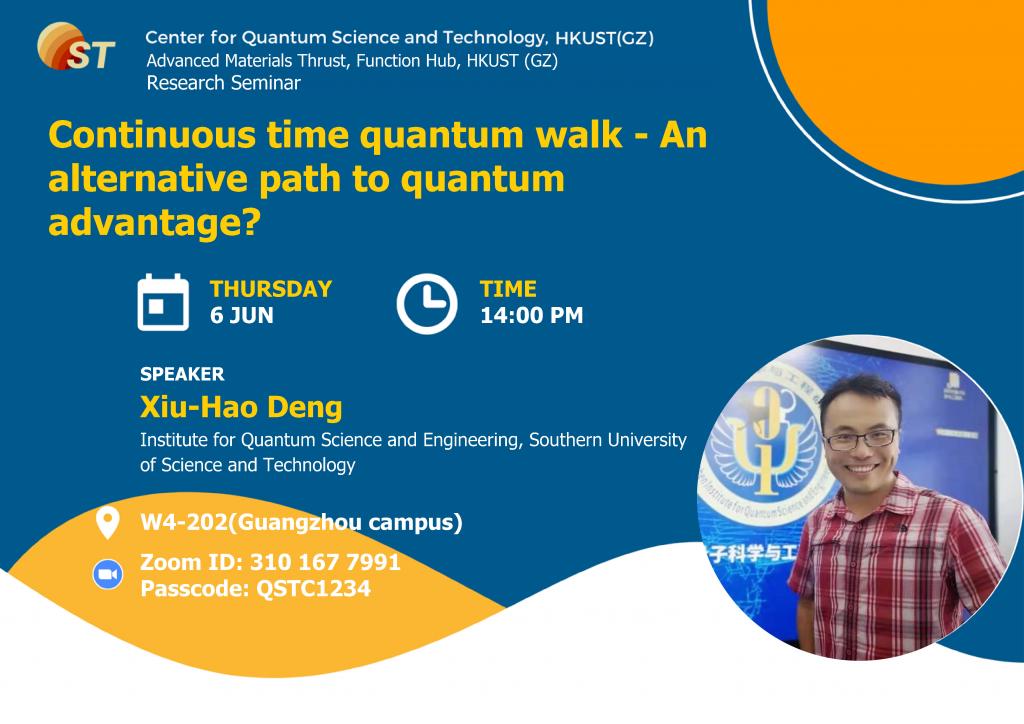
QST Seminar - Continuous time quantum walk - An alternative path to quantum advantage?
Supporting the below United Nations Sustainable Development Goals:支持以下聯合國可持續發展目標:支持以下联合国可持续发展目标:
This seminar introduces Continuous Time Quantum Walks (CTQWs), a foundational concept in quantum computing with potential for algorithmic speedups. We'll explore the theoretical basis of quantum walks, contrasting them with classical random walks to highlight their unique advantages. The session will cover how CTQWs inspire quantum computing algorithms and discuss the practical challenges and methods for implementing them on quantum computers. We'll also touch on the diverse applications of CTQWs, from cryptography to material science, providing insights into their transformative potential. Aimed at graduate students, this seminar will bridge the gap between quantum theory and practical computation, offering a clear understanding of CTQWs' role in advancing quantum technologies.
Xiu-Hao Deng, Associate Researcher (PI) of the Quantum Dynamics and Quantum Control group at the Institute of Quantum Science and Engineering in SUSTech, adjunct researcher of Shenzhen International Quantum Academy. He obtains B.S. from the department of Modern Physics, University of Science and Technology of China (USTC), where he worked with professor Sixia Yu on quantum error correction. And he got Ph.D. from the school of Natural Sciences, University of California, Merced, where he worked with professor Raymond Chiao on quantum optics using superconducting circuits. He worked as a postdoc for Sophia and Ed Barnes in VirginiaTech on quantum control. He joined current institute in late 2018. Xiu-Hao produced some original work in quantum control theory and quantum dynamics. He also did some innovative work in superconducting quantum circuits and quantum simulation. His current interests include practical quantum algorithms and quantum simulation leading to quantum advantages, quantum control on solid state qubits, many-body quantum dynamics, and so on.