IPE THRUST SEMINAR | Peer Learning, Enforcement, and Reputation
Supporting the below United Nations Sustainable Development Goals:支持以下聯合國可持續發展目標:支持以下联合国可持续发展目标:
We consider a two-period collective experimentation model featuring self-interested agents that test a sequentially-rational principal’s enforcement propensity through their misconduct and a principal that disciplines them to build a reputation for strict enforcement. We find that allowing peer learning between the agents yields more misconduct than an opaque setting because enforcement externalities, which heighten agent misconduct, dominate information externalities, which weaken misconduct. We also find a principal with a longer decision horizon may induce higher agent misconduct. Our results apply to various institutional settings, including relations between headquarters and divisions, common owners and portfolio firms, and regulators and firms.
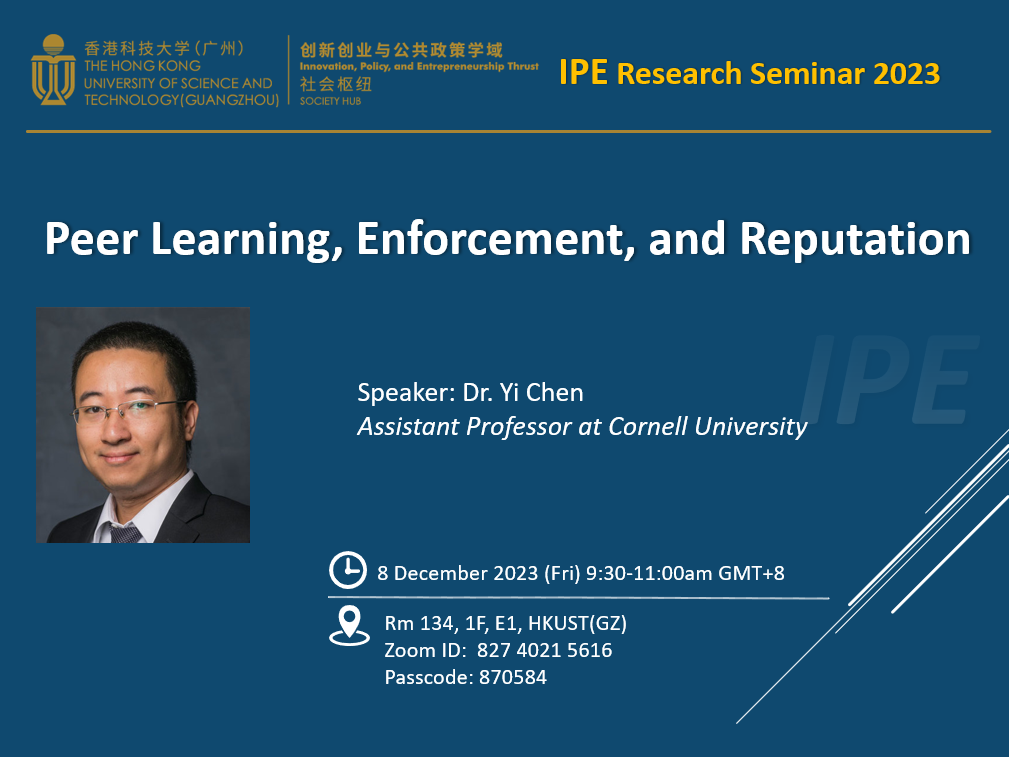
Yi Chen is an Assistant Professor of Economics at Cornell University. He received his PhD of Economics at Yale University, with a focus on game theory, industrial organization and mechanism design. His research includes both theoretical and applied approaches to principal-agent problems, dynamic games, and organizational economics.