Study on the Human-In-Loop Based Intelligent Methods for Industrial Assembly
Supporting the below United Nations Sustainable Development Goals:支持以下聯合國可持續發展目標:支持以下联合国可持续发展目标:
Robots play significant roles in reducing human labor costs, increasing work efficiency and improving product quality. As the speed of product renewal accelerates, the demand for flexible lines is becoming more and more evident for small batches or multi-types production. However, most current robots still have large gaps in mechanism, perception and control capabilities compared with humans, making it difficult to adapt to the varying scenarios or tasks. In contrast, humans are better at handling incomplete, contradictory and ambiguous information. Therefore, communion with humans and the environment is an important approach to solving the problem of insufficient robot intelligence.
This research focuses on robotic assembly operations and explores the theoretical and practical aspects of robotics in “human-in-the-loop” scenarios, developing methods of multimodal perception, knowledge inference and precise and compliant control, and building a validation system for intelligent robots’ complex assembly operation.
The main research contents include 1) behavior intent understanding method by fusion of environment perception and voice command; 2) semantic reasoning and guidance developments mechanism of assembly process based on the knowledge graph; 3) human-robot collaborative force position sharing control technology based on touch force. Finally, the robot assembly application demonstration for typical scenarios of intelligent robots is carried out to validate the proposed intelligent learning methods.
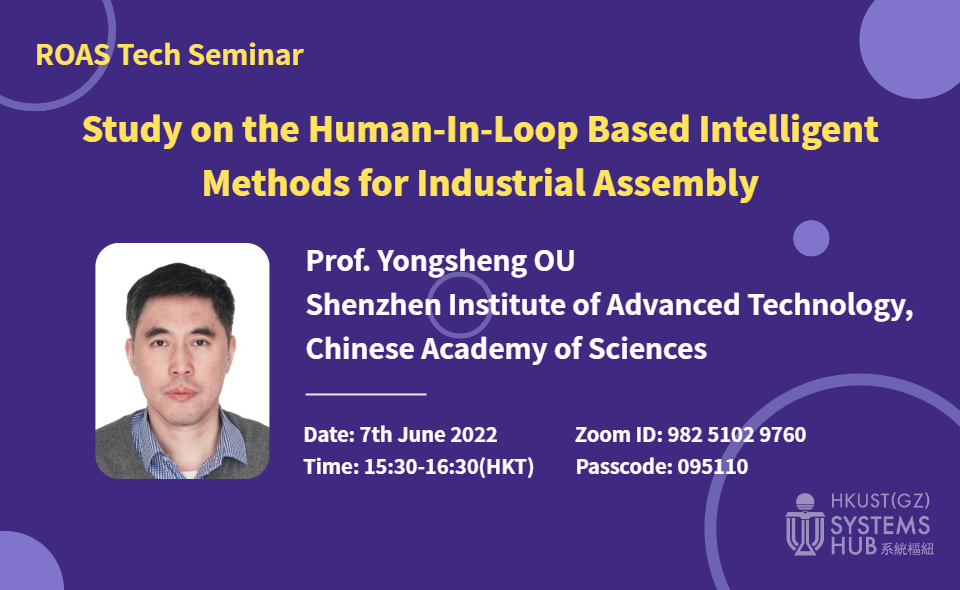
Professor Yongsheng OU is a Professor at the Shenzhen Institute of Advanced Technology, Chinese Academy of Sciences.
After returning to China from the United States in 2010, he was approved as the leading talent of the “Ten Thousand Plan” - National high-level talents special support plan, “One-hundred Talents Program” of the Chinese Academy of Sciences (CAS), the Science & Technology Nova Program of the Ministry of Science and Technology, the special support program for high-level talents in Guangdong Province, and Shenzhen Overseas High-level Talents “Peacock Program”. In recent years, he has presided the Chinese National Programs for High Technology Research and Development (863 Plan), Key projects of National Natural Science Foundation of China, the Ministry of Science and Technology 2030- “New Generation Artificial Intelligence” major projects, Guangdong Province key field research and development programs and other important projects at all levels, which have accumulated more than 60 million yuan in funds.
He has published more than 50 SCI papers in control and robotics, including more than 20 papers indexed by JCR Q1 journals. He has published one monograph in English. A number of his developed key technologies have been applied for more than 60 patents and have been gradually transformed into the products of SINSUN, Silver Star Robot, UBTECH and other companies.
He has won many awards, such as Guangdong Technology Invention Award, Wu Wenjun Artificial Intelligence Science and Technology Award and Shenzhen Science and Technology Progress Award. In 2020, he led his student team to participate in the Trico Robot Challenge of the World Robot Competition as a mentor and won the first and best creativity prizes in the dual-arm cooperative robot track.