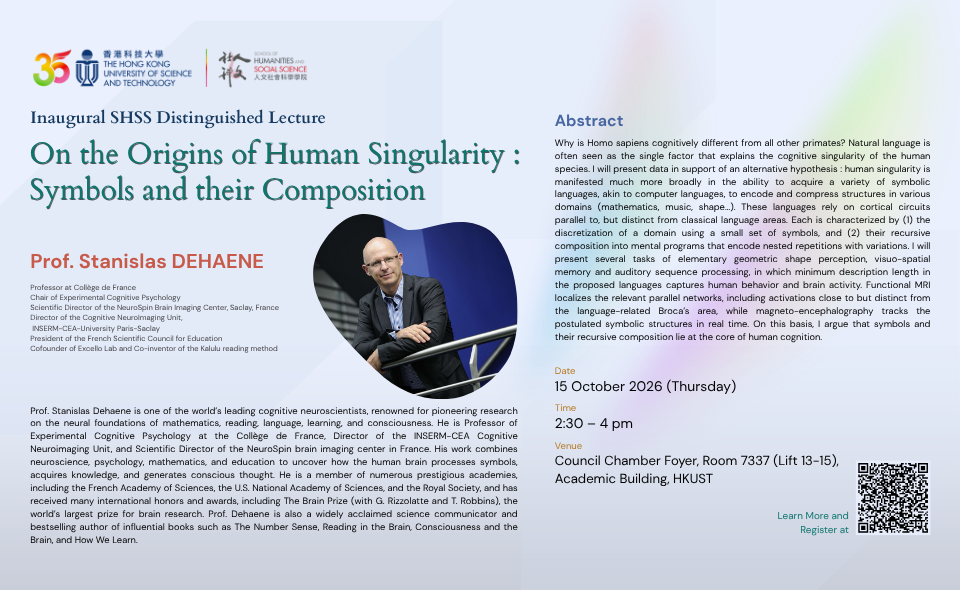
Inaugural SHSS Distinguished Lecture Series - On the origins of human singularity : Symbols and their composition
Supporting the below United Nations Sustainable Development Goals:支持以下聯合國可持續發展目標:支持以下联合国可持续发展目标:
Speaker
Stanislas Dehaene
Professor at Collège de France, Chair of Experimental Cognitive Psychology
Scientific Director of the NeuroSpin Brain Imaging Center, Saclay, France
Director of the Cognitive NeuroImaging Unit, INSERM-CEA-University Paris-Saclay
President of the French Scientific Council for Education
Cofounder of Excello Lab and Co-inventor of the Kalulu reading method
Abstract
Why is Homo sapiens cognitively different from all other primates? Natural language is often seen as the single factor that explains the cognitive singularity of the human species. I will present data in support of an alternative hypothesis : human singularity is manifested much more broadly in the ability to acquire a variety of symbolic languages, akin to computer languages, to encode and compress structures in various domains (mathematics, music, shape…). These languages rely on cortical circuits parallel to, but distinct from classical language areas. Each is characterized by (1) the discretization of a domain using a small set of symbols, and (2) their recursive composition into mental programs that encode nested repetitions with variations. I will present several tasks of elementary geometric shape perception, visuo-spatial memory and auditory sequence processing, in which minimum description length in the proposed languages captures human behavior and brain activity. Functional MRI localizes the relevant parallel networks, including activations close to but distinct from the language-related Broca’s area, while magneto-encephalography tracks the postulated symbolic structures in real time. On this basis, I argue that symbols and their recursive composition lie at the core of human cognition.