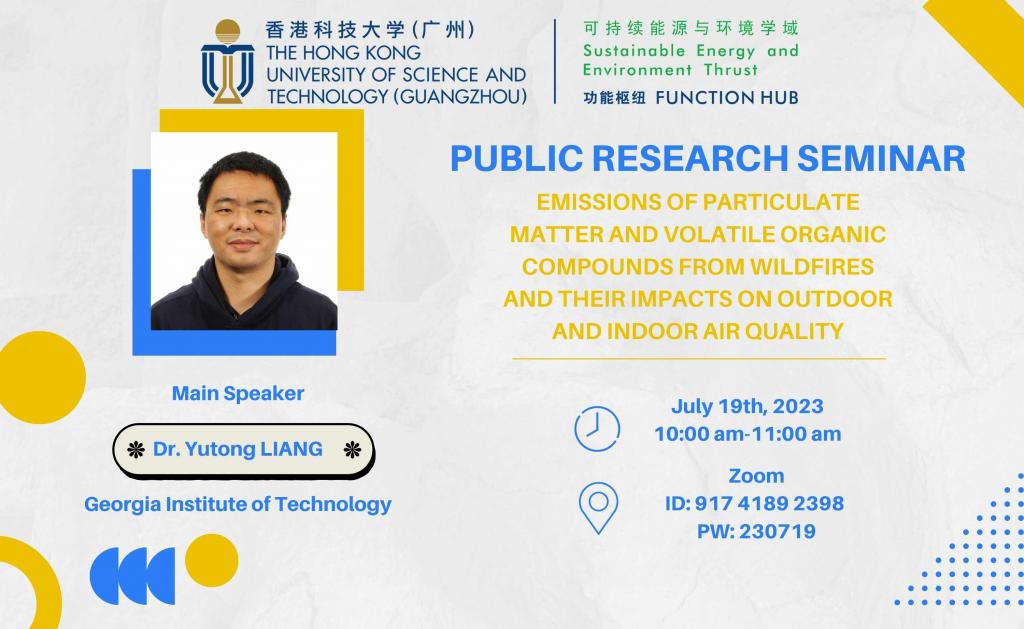
Public Research Seminar by Sustainable Energy and Environment Thrust, Function Hub, HKUST(GZ) - Emissions of Particulate Matter and Volatile Organic Compounds from Wildfires and their Impacts on Outdoor and Indoor Air Quality
Supporting the below United Nations Sustainable Development Goals:支持以下聯合國可持續發展目標:支持以下联合国可持续发展目标:
Due to a combination of climate change and fire suppression, wildfires are becoming larger and more frequent in the western United States. Biomass burning is the largest global source of carbonaceous particulate matter (PM), and the second largest global source of volatile organic compounds (VOCs) in the atmosphere. Many of these emissions have human health impacts, and their atmospheric transformations produce hazardous secondary pollutants. However, there is a lack of comprehensive molecular-level understanding of organic compounds in wildfire smoke, due to the chemical complexity and wildfires’ relatively episodic nature. Also, since people mainly shelter indoors during smoke events, the infiltration of smoke particles into buildings determines people’s exposure to PM. However, the protection against smoke provided by buildings is usually overlooked in exposure assessments. In this talk, I will focus on the non-targeted characterization of PM and VOCs from wildfires, the impact of atmospheric aging on these smoke ingredients, and the effects of fire emissions on urban ozone formation. I will also show how the indoor air quality in California buildings was affected by wildfires, using data acquired by low-cost PurpleAir particle sensors.
Dr. Yutong Liang is a postdoctoral researcher in Professor Nga Lee Ng’s group at Georgia Institute of Technology. Yutong graduated from the Hong Kong Polytechnic University with a BSc in Environment and Sustainable Development (2014) and received his MS in Civil and Environmental Engineering (2015) and PhD in Environmental Science, Policy, and Management (2022), both at the University of California, Berkeley. Yutong’s research focuses on fundamental and policy-relevant questions in air pollution in both indoor and outdoor environments. This includes detailed examinations of wildfire smoke emissions, their chemical transformation in the atmosphere, and their air quality impacts using advanced mass spectrometry tools and low-cost sensors. His recent postdoctoral work involves using long-term measurement data to explain the trend of aerosol mass and composition in the southeastern United States, as well as using fast-response mass spectrometry tools to decipher indoor ozone chemistry.
For inquiries, please contact Miss Suggi WU (+86-20-88332966, suggilswu@ust.hk)