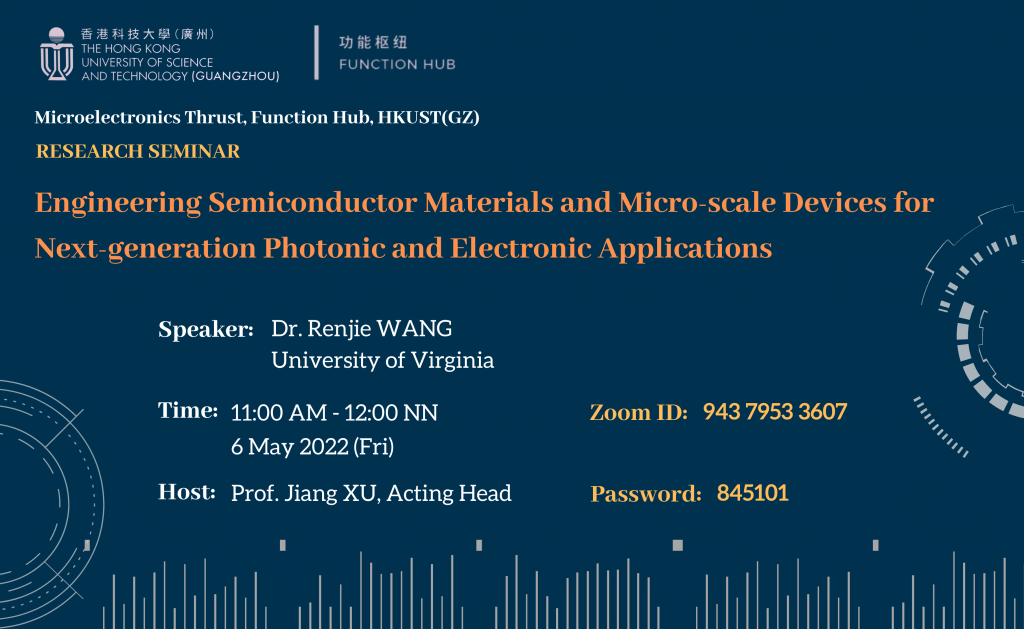
Public Research Seminar by Microelectronics Thrust, Function Hub, HKUST (GZ) - Engineering Semiconductor Materials and Micro-scale Devices for Next-generation Photonic and Electronic Applications
Supporting the below United Nations Sustainable Development Goals:支持以下聯合國可持續發展目標:支持以下联合国可持续发展目标:
“More than Moore” technologies require the use of micro- and nano-scale materials and devices for integration into a limited space, heterogeneous integration of existing device functions, miniaturization of circuits and systems, and others. In this talk, I will present the development of various micro-scale device components by engineering materials and device structures. These device realizations are based on different material systems spanning the ultraviolet (UV) to the infrared (IR) regimes. III-nitride nanocrystals have emerged as the building blocks of future UV-visible optoelectronic and electronic devices. Driven by the needs for reduced power consumption and enhanced efficiency and functionality, future ultrahigh resolution display and smart lighting technologies require the development of small size, efficient, multi-color light sources monolithically integrated on a single chip. Through the monolithic integration of blue, green, red, and yellow/orange InGaN nanocrystal LEDs on Si substrate or GaN/sapphire substrate, controllable and tunable full-color light generations were realized by using selective area growth and fabrication. Three approaches to monolithic integration have been investigated to realize micro-scale pixels. To suppress nonradiative surface recombination of InGaN nanocrystal LEDs, spontaneously formed core-shell structures have been realized to enhance their carrier lifetime and output power. In addition, selective area epitaxy technique of GaN-based nanocrystals has been realized using n-Si as a conductive substrate. Device applications including LEDs, solar cells, and photoelectrochemical hydrogen production have been demonstrated using (Al)InGaN nanorod arrays precisely grown on Si. For the infrared regime, Er3+-Yb3+ doped oxide platforms for on-chip optical amplification, flexible Ge films, and n-barrier-n III-V photodetectors will be discussed.
Dr. Renjie Wang received the B.S. degree in energy engineering from Zhejiang University, Hangzhou, China, in 2010, the M.S. degree in mechanical engineering from University of Houston, Houston, United States, in 2012, and the Ph.D. degree in electrical engineering from McGill University, Montreal, Canada, in 2018. In 2019-2020, he was a Postdoctoral Scholar with the Engineering Physics at McMaster University, Hamilton, Canada. He is currently a Research Associate with the Electrical and Computer Engineering, University of Virginia, Charlottesville, United States. His research interests include design, epitaxy, micro/nano fabrication, and characterization of novel semiconductor materials and devices, and their device integrations for photonic and electronic applications.