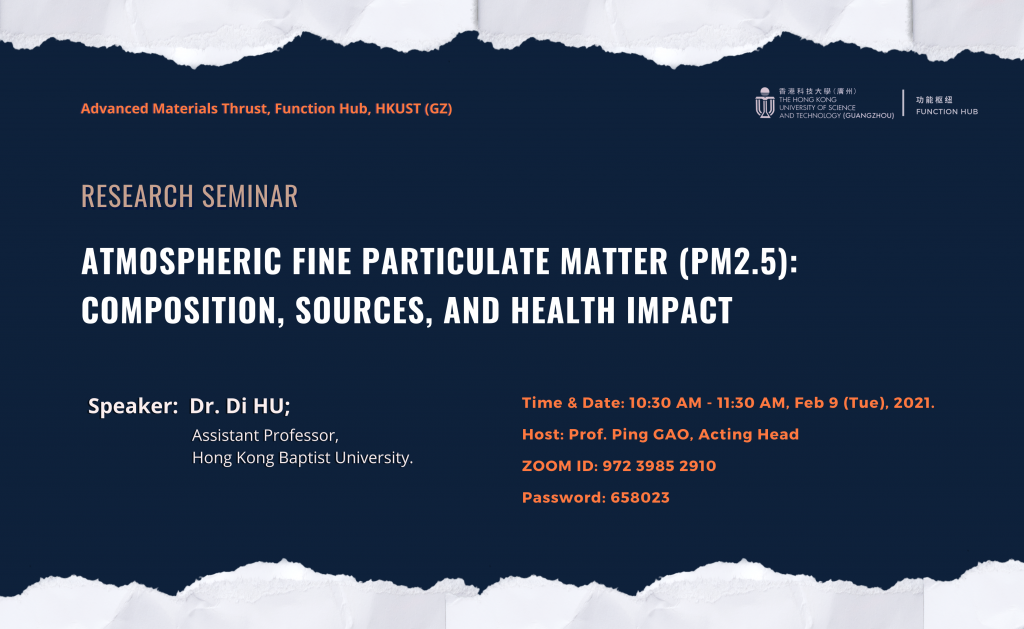
Public Research Seminar by Advanced Materials Thrust, Function Hub - Atmospheric Fine Particulate Matter (PM2.5): Composition, Sources, and Health Impact
Supporting the below United Nations Sustainable Development Goals:支持以下聯合國可持續發展目標:支持以下联合国可持续发展目标:
Increasing scientific findings show that the adverse health effects of atmospheric fine particulate matter (PM2.5) are related not only to its mass but also to PM2.5 sources and chemical compositions. Pollutants in PM2.5 may be transported into the human respiratory system, perturb the redox equilibrium through the generation of reactive oxygen species (ROS), and thus lead to various health effects. Here, we conducted a comprehensive characterization and source apportionment of PM2.5 and the ROS activity associated with water-soluble PM2.5. Two ROS indicators, namely dithiothreitol (DTT) consumption and ∙OH formation, were quantified. Six PM2.5 sources, i.e., secondary sulfate, biomass burning, secondary organic aerosol (SOA), vehicle emissions, marine vessels, and a metal-related factor, were apportioned and identified to be DTT active. The four primary sources accounted for 83.5% of DTT activity of water-soluble PM2.5, with the metal-related factor and marine vessels as the leading contributors. However, only three sources, i.e., metal-related factor, vehicle emissions, and SOA, showed ∙OH generation ability, with a predominant contribution of 96.2% from the two primary sources, especially the metal-related factor (84.5%). These results indicate that pollutants from primary sources dominate the water-soluble PM2.5 induced ROS activity.
We then used embryo zebrafish (AB strain) as a model to assess the total PM2.5 toxicity. The genome-wide transcriptional analysis showed that the identified differentially expressed genes (DEGs) in PM2.5 extract-treated zebrafish embryo samples were mainly associated with responses to xenobiotic stimulus and muscle and heart development and functions. An integrated multivariate method, i.e., L2-normalization integrated positive matrix factorization (PMF), was developed to analyze the high throughput biological and chemical data simultaneously and quantitatively evaluated the source-specific DEG-inducing ability of PM2.5. PM2.5 from combustion-related sources (e.g., traffic, metal-related industry, and biomass burning) and sea salt showed a more vital ability to induce DEGs than secondary aerosol sources and are mainly associated with reproductive, developmental, and hormone-related biological pathways. This suggests that more stringent controls on particulate emissions from primary sources, especially the combustion activities, could effectively reduce the health impacts of PM2.5 pollution. Results from this study have provided us a much more comprehensive understanding of the relative toxicity of PM2.5 from various sources, which may aid the formulation of more targeted and optimized control measures to reduce PM2.5 pollution.
Dr. Di Hu obtained her B.Sc. degree in Applied Chemistry from Peking University and Ph.D. in Atmospheric Chemistry from the University of North Carolina at Chapel Hill. After her post-doctoral research at Hong Kong University of Science and Technology, Dr. Hu joined Hong Kong Baptist University and is currently a tenure-track Assistant Professor in the Department of Chemistry. Her current research focuses on 1) the origins and chemical transformations of organic pollutants in the atmosphere; 2) development and application of mass-spectrometry based techniques to analyze various organic species and elements in PM2.5 and other complex matrices; 3) characterization and source apportionment of PM2.5 and PM-associated toxicity. Dr. Hu also has extensive research experience in smog chamber experiments and kinetic modeling of organic aerosol formation. She has published scientific papers in reputable international journals in the field, including Atmospheric Chemistry and Physics, Journal of Geophysical Research-Atmosphere, Journal of Hazardous Materials, Environmental Pollution, etc.