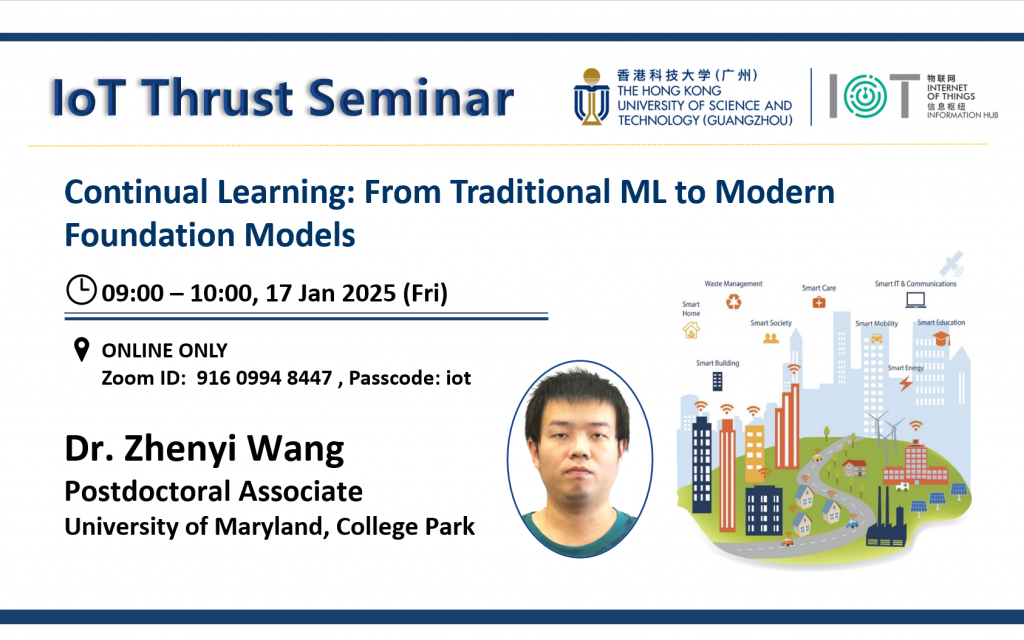
IoT Thrust Seminar | Continual Learning: From Traditional ML to Modern Foundation Models
Supporting the below United Nations Sustainable Development Goals:支持以下聯合國可持續發展目標:支持以下联合国可持续发展目标:
Deep learning has driven remarkable progress across diverse domains, yet most methods operate under the assumption of stationary data distributions. However, in real-world scenarios, data distributions evolve over time, posing significant challenges such as catastrophic forgetting and the need to balance performance across both old and new tasks. These challenges are particularly critical in (1) resource-constrained environments, such as edge devices, and (2) large language models, where the initial pre-training data is often unavailable after the model's deployment.
In this talk, I will first present approaches to tackle these challenges from three complementary perspectives: data-centric, biology-inspired, and model-centric, all aimed at building solid theoretical foundations for continual learning. Extending beyond conventional continual learning, I will also explore advancements tailored to foundation models, including vision transformers and large language models (LLMs). Finally, I will share my research vision and outline future directions for enabling continual learning in dynamic, real-world settings.
Zhenyi Wang is a Postdoctoral Associate at the University of Maryland, College Park. He earned his Ph.D. in Computer Science from the State University of New York at Buffalo, a Master’s degree from Western University in Canada, and a Bachelor’s degree from Northeastern University in China. His research focuses on continual learning, trustworthy AI, model merging, and data-efficient learning. He has published more than 30 papers in top-tier conferences and journals, including ICML, ICLR, NeurIPS, CVPR, ICCV, ECCV, ACL, and TPAMI.